
The Breeding Bird Atlases of Hertfordshire
The three Atlases of Breeding Birds in Hertfordshire contain the results of fieldwork carried out by the Hertfordshire Natural History Society. The first of these, “The Hertfordshire Breeding Atlas”, published in 1982 contains the results of the fieldwork carried out between 1967 and 1973. The second, “The Breeding Birds of Hertfordshire”, published in 1993 contains the fieldwork carried out between 1988 and 1992. The third, “The Birds of Hertfordshire” published in 2015 contains the fieldwork carried out between 2007 and 2012. For historical clarity I have referred to these as the 1973, 1992 and 2012 Breeding Atlases respectively, being the years that the fieldwork was completed.
The Atlases are based on the Ordnance Survey Map. Each ten kilometre square shown on the 1:50000 scale Land Ranger Ordnance Survey maps by a dark blue square contains 1 kilometre squares shown by light blue squares, 100 per 10 kilometre square. 4 of these 1 kilometre squares form a larger square 2 kilometres long, this is known as a “tetrad”, from the Greek word, “tetra” meaning 4. Thus, each 10 kilometre square comprises 25 tetrads. Each of these tetrads was surveyed by fieldworkers in the relevant years during the months of April to July, and the results were published in respect of them.
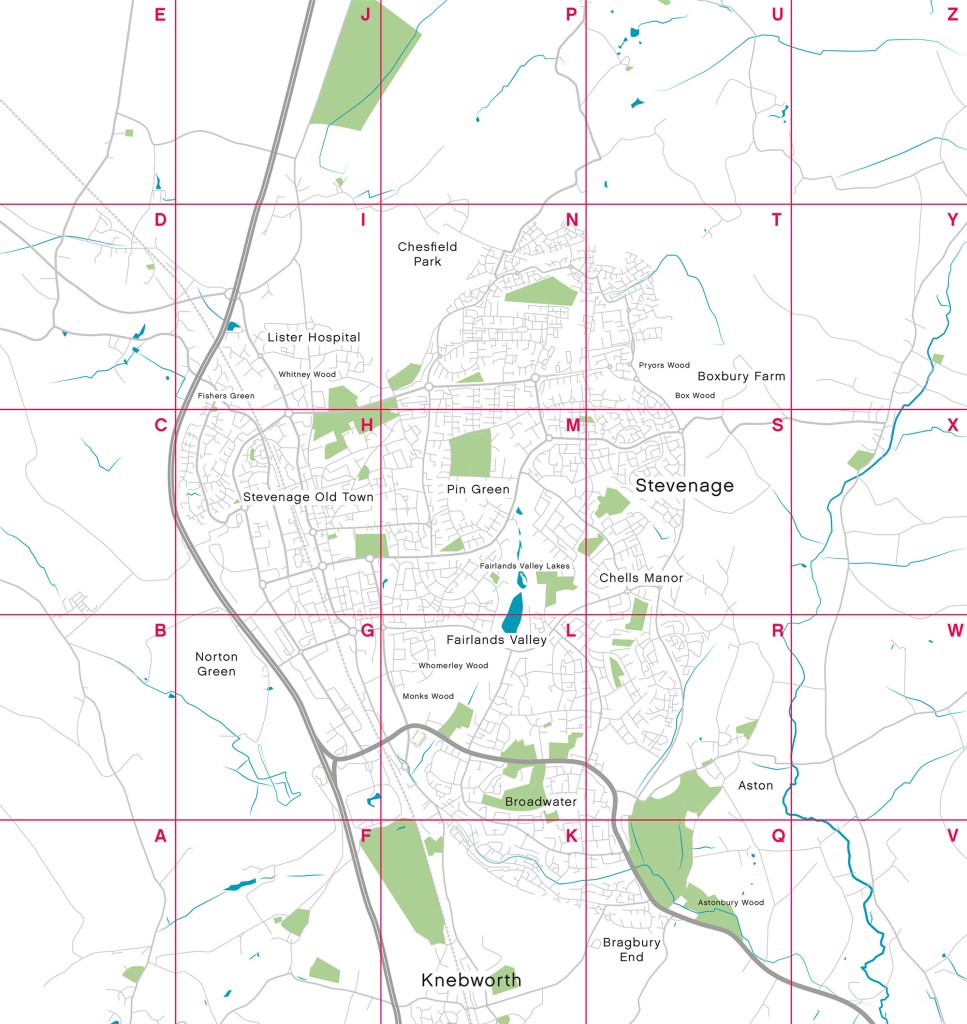
The area covered by this site falls wholly within the 10 kilometre square, TL22, and comprises 11 of the tetrads in that square. Each of the Tetrads covering Stevenage are given a letter and a principle place name.
The “Stevenage” Tetrads are:
TL22 G – Norton Green (Norton Green Tip and Watery Grove are within this tetrad).
TL22 H – Stevenage Old Town
TL22 I – Lister Hospital (Fishers Green and Whitney Wood are within this tetrad).
TL22 K – Knebworth (This square covers parts of Broadwater and Bragbury End)
TL22 L – Broadwater (Fairlands Valley, part of the Main Sailing Lake, Whomerley Wood and Monks Wood are within this tetrad).
TL22 M – Pin Green (Apart from part of the Main Sailing Lake, Fairlands Valley Lakes is within this tetrad).
TL22 N – Chesfield Park
TL22 Q – Bragbury End (Astonbury Wood is within this tetrad).
TL22 R – Aston
TL22 S – Chells Manor
TL22 T – Boxbury Farm (Box Wood and Pryors Wood is within this tetrad).
During the fieldwork each species seen was categorised as, possible, probable or confirmed breeding. These categories are defined as follows:-
Possible breeding – birds seen during the breeding season in suitable habitat.
Probable breeding:
- Singing male or breeding calls heard on more than 1 occasion
- Bird (or pair) apparently holding territory
- Nest building or excavation
- Birds visiting probable nest site
- Birds showing courtship display or behaviour
Confirmed breeding :
- A nest located containing eggs or young
- Adult Birds seen carrying food for the young
- Adult Birds seen carrying a faecal sack
- Recently fledged young seen
- A nest used in the current year found
- Adult Birds seen visiting or leaving a nest site in circumstances indicating that the nest was in use
- Birds observed performing a distraction display
The following is a table of the birds confirmed as breeding in the three Atlases. The period between the 1973 and 1992 Atlases saw the development of the Symonds Green, Bragbury End/Hertford Road and Chells Manor areas of the town, and the establishment of Fairlands Valley Lakes. The period between the 1992 and 2012 Atlases saw the development of the Poplars and Great Ashby areas. These developments were small in comparison with the scale of development between 1946 and 1973.
| Species | 1973 (Number of Tetrads) |
1992 (Number of Tetrads) |
2012 (Number of Tetrads) |
|---|---|---|---|
| Canada Goose | 0 | 2 | 2 |
| Mallard | 3 | 8 | 5 |
| Red-legged Partridge | 3 | 3 | 0 |
| Grey Partridge | 1 | 0 | 0 |
| Common Pheasant | 7 | 4 | 0 |
| Great Crested Grebe | 0 | 1 | 0 |
| Red Kite | ** | ** | 1 |
| Sparrowhawk | 0 | 4 | 1 |
| Buzzard | 0 | 0 | 1 |
| Kestrel | 3 | 3 | 2 |
| Moorhen | 7 | 11 | 9 |
| Coot | 0 | 1 | 2 |
| Little Ringed Plover | 0 | 1 | 0 |
| Lapwing | 6 | 1 | 0 |
| Woodcock | 1 | 0 | 0 |
| Feral Pigeon | * | 4 | 0 |
| Stock Dove | 1 | 5 | 0 |
| Woodpigeon | 8 | 11 | 6 |
| Collared Dove | 2 | 8 | 6 |
| Turtle Dove | 4 | 3 | 0 |
| Cuckoo | 1 | 4 | 0 |
| Little Owl | 1 | 0 | 0 |
| Tawny Owl | 2 | 4 | 0 |
| Swift | 5 | 5 | 2 |
| Green Woodpecker | 0 | 1 | 4 |
| Green Spotted Woodpecker | 3 | 3 | 5 |
| Lesser Spotted Woodpecker | 2 | 0 | 0 |
| Skylark | 4 | 6 | 2 |
| Swallow | 8 | 7 | 2 |
| House Martin | 9 | 6 | 2 |
| Tree Pipit | 1 | 0 | 0 |
| Meadow Pipit | 1 | 0 | 0 |
| Pied Wagtail | 5 | 9 | 5 |
| Wren | 7 | 11 | 5 |
| Dunnock | 9 | 11 | 7 |
| Robin | 11 | 11 | 11 |
| Nightgale | 2 | 0 | 0 |
| Blackbird | 11 | 11 | 11 |
| Song Trush | 11 | 11 | 7 |
| Mistle Trush | 6 | 10 | 1 |
| Sedge Warbler | 0 | 1 | 0 |
| Blackcap | 5 | 8 | 1 |
| Garden Warbler | 5 | 5 | 0 |
| Lesser Whitethroat | 1 | 4 | 0 |
| Common Whitethroat | 5 | 7 | 6 |
| Chiffchaff | 6 | 10 | 2 |
| Willow Warbler | 7 | 10 | 0 |
| Goldcrest | 3 | 8 | 1 |
| Spotted Flycatcher | 6 | 9 | 0 |
| Long-tailed Tit | 9 | 10 | 8 |
| Blue Tit | 11 | 11 | 10 |
| Great Tit | 11 | 11 | 11 |
| Coal Tit | 2 | 7 | 5 |
| Willow Tit | 4 | 4 | 0 |
| Marsh Tit | 2 | 2 | 1 |
| Nuthatch | 3 | 3 | 3 |
| Treecreeper | 5 | 7 | 1 |
| Jay | 4 | 5 | 0 |
| Magpie | 3 | 11 | 8 |
| Jackdaw | 8 | 10 | 4 |
| Rook | 9 | 6 | 10 |
| Carrion Crow | 4 | 11 | 8 |
| Starling | 11 | 11 | 10 |
| House Sparrow | 11 | 11 | 10 |
| Tree Sparrow | 7 | 1 | 0 |
| Chaffinch | 9 | 10 | 3 |
| Greenfinch | 6 | 9 | 6 |
| Goldfinch | 9 | 7 | 5 |
| Linnet | 7 | 5 | 0 |
| Lesser Redpoll | 1 | 2 | 0 |
| Bullfinch | 8 | 8 | 2 |
| Hawfinch | 3 | 2 | 0 |
| Yellowhammer | 6 | 10 | 3 |
| Reed Bunting | 2 | 3 | 0 |
| Corn Bunting | 1 | 3 | 0 |
* Not surveyed for the 1973 Atlas.
** Not surveyed for the 1973 and 1992 Atlases.
WINTERING ATLAS 2007/8 TO 2011/12
In addition to the 2012 Breeding Bird Atlas, fieldwork was also carried out by the Hertfordshire Natural History Society during the winters of 2007/8 to 2011/12. Each of the same tetrads, as used in the Breeding Bird Atlases, was surveyed by fieldworkers during the months of November to February to record the numbers and species using the particular tetrad. This is referred to as the 2012 Winter Atlas
COMMON BIRD CENSUS AT WATERY GROVE
The Common Bird Census is organised by the British Trust for Ornithology, individual field workers map the positions of individual birds at a nominated plot, and note their territorial behaviour during 10 visits to the site during the breeding season using a standard technique to estimate the number of breeding territories within the clearly defined census plots.
Nigel Agar carried out part of the census at Watery Grove (BTO Plot 037) from 1972 to 1999.
WETLANDS BIRD SURVEY AT FAIRLANDS LAKES
The inland Wetlands Bird Survey (WeBS) is organised nationally by the Wildfowl and Wetlands Trust. On a designated day each month counts of the more common species of Grebes, Cormorants, Herons, and Wildfowl are made. A monthly count at Fairlands Valley Lakes began in June 2003.
 The History of the Birds of Stevenage