
One was seen at an unrecorded location on 30 August 2024.
[ thought or known species of introduced or captive origin ]
One was seen at an unrecorded location on 30 August 2024.
[ thought or known species of introduced or captive origin ]
Occasional winter visitor in small numbers.
Foster (1914) recorded that Bramblings were, “frequently noted at Stevenage.”
Prior to the 1980’s reasonable sized flocks had been recorded from Stevenage; 30 to 40 at Box Wood on 15 April 1968; 11 in a mixed flock of finches near Brooches Wood on 30 October 1974; 20 at Watery Grove on 16 February 1978. Between one and three birds were also recorded from, Astonbury, Chells, Chesfield Manor Park, and, Pryors Wood. Also, small numbers were seen in Fairlands Valley in the winter of 1968/69.
There is also an interesting record of a male in full breeding plumage with three females at Chesfield Manor Park on 15 April 1967.
During the 1980’s there were only four records, coming from, Astonbury, Lonsdale Road and, Watery Grove (where one was heard singing on 12 April 1980) and, only one record during the 1990’s (at an unrecorded location).
Between 2000 and 2009 there were the following records: a female in a Lonsdale Road Garden on 20 February 2001; four at Great Ashby and two at Ripon Road on 16 November 2007; one ringed at Fishers Green on 17 November 2007; three at Fairlands Lakes on 21 January 2008; one in a garden on 23 March 2008; one in a Great Ashby Garden on 16 November 2008; five at Great Ashby on 29 March 2009; nine at Great Ashby on 30 March 2009; male in a Great Ashby Garden on 16 November 2008; a male feeding and bathing in a garden on 1 December 2009.
Between 2010 and 2019 there were the following records: one at Aston Allotments on 16 October 2012 and, 19 October 2015; one at an unrecorded location on 17 January 2017; one at Watery Grove on 19 March 2018; two males and, a female in a Chells Manor Garden on 27 March 2018 and a male on 2 April; a male in a Great Ashby Garden on 3 April 2018; one at Fairlands Valley Lakes on 11 November 2018; a female on a garden feeder on 16 March 2019; one at Box Wood on 23 March 2019; two at Ashtree Wood on 24 March 2019.
Since 2020 they have been recorded from: Box Wood, a male on 5 March 2020; Aston End Road, two on 25 October 2020; Great Ashby a male on 18 December 2020; Great Ashby Park one on 24 March 2021; Stanley Road one on 8 October 2021; Fairlands Valley Lakes, three plus on 12 October and one plus on 14 October 2021; two plus near Great Ashby Park on 20 November 2021; a male in a Great Ashby garden on 17 and 18 February 2022; two in a Great Ashby garden on 20 February 2022; one at Fairlands Valley Lakes on 1 and 21 March 2022; six plus at Watery Grove on 2 April 2023; a male in a Great Ashby Garden between 25 and 30 January 2025; one over Stanley Road on 13 October 2025; a male in a mixed flock of c.500 Finches and Buntings at Potters Spring between 28 December 2025 and 14 February 2026.
The 2012 Winter Atlas confirmed their presence from four of the tetrads covering Stevenage.
Common resident and winter visitor.
Between 1956 and 1963 huge numbers of Chaffinches died, particularly in south east England as a result of the use of organochlorine chemicals in agriculture.
They were confirmed as breeding from nine of Stevenage’s tetrads in the 1973 Breeding Atlas, 10 in the 1992 Atlas and, three in the 2012 Atlas.
The 2012 Winter Atlas confirmed their presence from all 11 of the tetrads covering Stevenage.
The Common Bird Census at Watery Grove recorded Chaffinches as holding between one and fourteen breeding territories annually between 1972 and 1999. The lowest counts were in the 1970s with a steady increase from 1978. They were the only significant finch of the interior of the wood during that period, and appeared less dependent on coppicing.
Largest flocks recorded are: 50 in fields near Brooches Wood on 30 October 1974; 40 plus seen at Monks Wood/Whomerley Wood on 6 March 1977; 40 plus in a mixed finch flock at Norton Green Tip on 15 March 1980; 30 to 40 at Great Ashby Park in March 2025; 50 plus at Box Wood on 15 March 2025.
A mixed flock of c.500 Finches and Buntings at Potters Spring between 28 and 31 December 2025 was predominately comprised of Chaffinches and Linnets (Carduelis cannabina).
An influx of birds from the continent was noted at Box Wood on 24 October 1981 when 10 birds of the continental race F. c. coelebs were caught and ringed.
One ringed near Dublin in December 1983 was controlled at Stevenage in November 1984
Former resident of the town’s principal woodlands.
The Hawfinch is the largest of Britain’s native Finches, and the most elusive. They inhabit mature broad leaved woodlands, especially those with good stands of Hornbeam or Cherry. In winter they form small flocks and disperse locally and, sometimes visit gardens. They are vulnerable during cold winters. Nationally their breeding population and, range are in decline.
The 1879 Hertfordshire Bird Report contained a comment that Hawfinches were, “adept at stripping and shelling peas and, in gardens are said to be more destructive than the Bullfinch”.
Foster (1914) described Hawfinches as, “locally common near Stevenage”. He also recorded that, “a pair nest annually in a garden close to the town”. In Hine, (1934), he recorded that they bred at Box Wood.
During the fieldwork for the 1973 Breeding Atlas the Hawfinch featured in more tetrads in the 10 Kilometre Square in which Stevenage falls than any other in the County, with breeding confirmed from three tetrads. Despite being confirmed as breeding in two of the tetrads covering Stevenage in the 1992 Atlas, they have declined dramatically and, apart from migratory birds are now probably extinct at Stevenage.
The decline in Hertfordshire is widespread and the reasons are unknown. In 1967 a decline was noted at Box Wood following the felling of an area that included Hornbeams.
The records for the principal sites where Hawfinches were formerly found at Stevenage are;
Astonbury Wood: several seen on 4 January 1969 feeding on Hawthorn seeds and one seen drinking on 5 March 1969; seen between 15 and 20 on 11 February 1973; present 1974; one on 20 May, 19 June, 17 July, 25 September, 29 September and 26 December 1977; two or, more birds heard calling in March and April 1978, a pair seen feeding newly hatched young on 21 July and, a pair calling on 20 August 1978; single bird April 1980; breeding confirmed June 1980, with a pair seen carrying food on 14 June; present in 1981; three seen in March and April 1989; nine on 20 January 1990; present in 1991; 10 on 24 February 1992; four on 8 March 1992.
Box Wood: Small party seen in the winter 1960; one seen on 20 May 1962; a pair with two young recorded in 1964; 12 on 25 February 1965, a pair on 28 March and 22 April 1965, three on 3 April, four on 22 May and, six on 11 December 1965; present all year 1966; one 27 June 1967; remains of a bird presumed to have been taken by a predator found on 17 April 1969; one on 31 June 1970; 20 on 8 October 1972; seen March and April 1973; present 1974; one in April 1976; one in August 1978; recorded in April, May and December 1979; four plus seen April 1980; a male two females and a juvenile ringed 1980, both females apparently nesting; four on 29 March and 30 May 1981; Adult males were ringed on 13 June and 4 July 1981 and, also a female on 4 July with a brood patch indicating breeding in the wood; two on 5 November 1982; one on 8 December 1982; several pairs bred in 1983; two on 18 May 1984; one on 7 June 1986; recorded in 1988; two males in 1989; one on 13 April 1991.
Fairlands Valley Lakes: One found dead in January 1978; recorded in 1980 and 1981; one on 27 February 1983; one on 28 May 1989.
Monks Wood: Nested in 1966 with several seen 30 April; one on 9 April 1967; indications of breeding 1967/8; seen on 2 September 1971; present 1972; seen from March to May 1973; six on 9 March 1974; 13 on 26 February 1989; three on 30 January 1994.
Pryors Wood: Present all year in 1981.
Watery Grove: seen from March to May 1971; seen March and April 1973; present 1974; seen on 10 occasions in 1975; two pairs nested in 1977; present in 1978, 1979 and 1980 (with up to three seen); six on 27 March 1981; seven on 2 April 1981; a pair present in 1983; present during the 1985 breeding season; pair present in 1989. The Common Bird Census recoded single breeding territories being held in 1972, 1975 and 1977, their presence in the 1979 breeding season, two territories being held in 1980 and 1982, and their presence in 1984, 1985, 1987, and 1989. Watery Grove remains typical Hawfinch habitat, and their present absence from the wood would appear to be part of their general decline.
Whomerley Wood: a pair 28 March and 22 April 1965; three on 3 April 1965; four on 22 May 1965; six on 11 February 1965; bred in 1969; over-wintered for the first time 1969/70; male and female drinking at the pond of the, “Moat Sanctuary” on 8 May 1970 and several young birds seen in the wood in July and August; numerous in 1971 (with breeding suspected); 13 on 13 February 1972; seen March and April 1973; nesting near the, “Sanctuary” 1974; between six and eight 21 March 1975; pair seen during the summer 1980; at least 20 on 30 March 1981; seven on 12 June 1981.
Two records away from the principal sites: one seen at The Nobel Grammar School, Mobbsbury Way on 2 May 1967 and single birds flying over Chells during April 1979.
More recent records are: two seen at Gresley Way on 31 March 2006. (During the 2005/2006 winter small flocks had been seen in the County which were believed to be of Continental origin); one heard calling in the “clearing” between Watery Grove and Cannocks Wood on 3 April 2014.
During the autumn of 2017 there was a considerable influx of birds to Britain due to crop failures in Germany and, Romania, with large flocks seen in Hertfordshire in the winter of 2017/18. At Stevenage birds up to 12 birds were seen between 22 January and 14 March 2018 at Upper Kitching Spring and, at Watery Grove, one was seen on 1 January and, 35 on 27 February 2018.
Small numbers of Hawfinches were ringed in Hertfordshire in the 1970’s and 1980’s, one ringed at Wheathampstead was found at Box Wood.
The most recent records are of one seen at Fairlands Valley Lakes on 14 November 2022, one at Fairlands Farmhouse on 27 October 2024 and one at Pin Green on 3 November 2024.
Uncommon resident in serious decline.
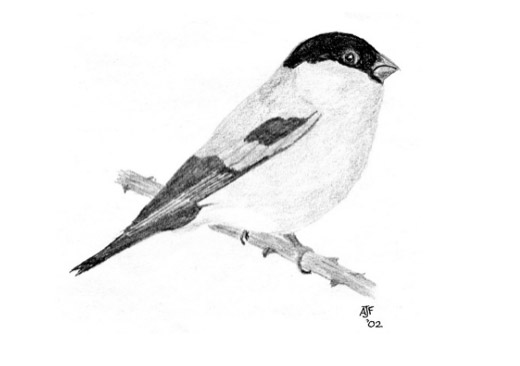
Following increases in their numbers during the 1950s and 1960s Bullfinches are now in decline, this has been linked to hedgerow and scrub loss. In the winter and early spring, they feed on flower and fruit buds, and their ability to strip buds from fruit trees resulted in their persecution during the nineteenth century by fruit growers and gardeners. In Hertfordshire one of their local names is “budpricker.” Crossman (1902) recorded that Bullfinches were, “rather shot down in those districts where fruit is cultivated to any extent.”
The records from the 1960s, 1970s and 1980s are: a male in a Raleigh Close Garden on 5 July and 25 August 1965; 12 at Box Wood on 11 December 1965; 12 at Box Wood on 26 November 1967; an increase noted in Monks Wood in 1967 and 1968; up to six feeding on the seeds of Norway Maple (Acer platanoides) in a Lodge Way Garden in 1969; a pair and two young feeding in a Stevenage Garden on Honeysuckle berries August 1970; 12+ in the Hertford Road area on 3 December 1973; seven Fairview Road 24 January 1974; nine Monks Wood 2 February 1974; eight by Botany Bay 8 November 1974; nesting near the “Sanctuary” in Whomerly Wood 1974; seen at Astonbury on 10 April and 12 June 1976; 12 at Astonbury on 18 December 1977; six females at the, “Greenhouse Garden”, Astonbury on 22 January 1978; one at Astonbury on 2 June 1978; 42 ringed at Box Wood in 1978; Astonbury 1979, 1980 and 1986; between eight and 11 birds Watery Grove 9 to 15 January 1980; Box Wood 11 May 1985. During this period, they were quite common locally.
During the 1990s records came from: Ashtree Wood; Edmonds Drive; Lanterns Lane; Monks Wood; New Wood, Aston; Norton Green Tip; Watery Grove; Whomerly Wood and, Wiltshire Spring. A large flock of 24 was seen on 6 September 1996 at an unrecorded location, which is the most seen together at Stevenage.
Between 2000 and 2009 they were recorded from: Ashtree Wood; Astonbury; Aston End; Barham Road; Dene Lane; Fairlands Valley Lakes; Fishers Green; Gresley Way; Lanterns Lane; Long Lane, Aston; Monks Wood; New Park Lane, Aston; Norton Green Tip; Ridlins Mire; River Beane, Aston; Symonds Green; Tatlers Lane, Aston End and, Watery Grove.
Between 2010 and 2019 they were recorded from: Aston Allotments; Astonbury Wood; Aston Recreation Ground; Broadwater Lane; Chesfield; Dene Lane; Dyes Lane; Norton Green Tip; River Beane, Aston; Short Lane, Aston; Watery Grove and six on a Stevenage Garden feeder in 2017.
Since 2020, when their decline locally has become more noticeable, they have been recorded from: Aston Allotments; Aston End Road; Between Great Ashby and Chesfield; Fairlands Valley Lakes; Sheafgreen Lane, Aston End; Short Lane, Aston and Watery Grove.
With no records from 2025, the most recent record is of three at Fairlands Valley Lakes on 11 January 2026.
They were confirmed as breeding from eight of Stevenage’s tetrads by both the 1973 and 1992 Breeding Atlases and, from two in the 2012 Atlas.
The Common Bird Census at Watery Grove recorded one breeding territory being held annually between 1972 and 1976. In 1977 and 1979 two territories were held. In the 1980’s single breeding territories were held in 1981, 1985, and 1987, and their presence was recorded in the 1984, 1988, and 1989 breeding seasons. In the 1990’s their presence was recorded in the 1991, 1992, 1993 and 1999 breeding seasons, single breeding territories held in 1994, 1995 and 1997, and two territories held in 1996.
The 2012 Winter Atlas confirmed their presence from seven of the tetrads covering Stevenage.
A bird ringed at Osterley, Middlesex in 1977 was, “controlled” at Stevenage on 30 June 1984. This is an unusual record as, the majority of, birds ringed in England are recorded within five kilometres of the ringing site.
Common resident.
In the past large winter flocks of Greenfinches were often recorded from stubble fields and wasteland, where they fed on weed seeds. As these food sources have diminished due to the intensification of farming methods they now use gardens as a suitable alternative food source.
Since 2005 Greenfinches have also been affected by a respiratory disease, trichomonsis, which has had an effect on their numbers.
They were confirmed as breeding from six of Stevenage’s tetrads in the 1973 Breeding Atlas, nine in the 1992 Atlas and, six in the 2012 Atlas.
The 2012 Winter Atlas confirmed their presence from all 11 of the tetrads covering Stevenage.
At Watery Grove, the Common Bird Census recorded between one and four pairs holding breeding territories between 1972 and 1983, the peak of four territories being recorded in 1979. From 1984 to 1999 only their presence in the breeding season was recorded.
The following large flocks have been recorded: 200 at Brooches Wood on 30 October 1974; 100+ at Astonbury Wood during March and April 1975; 100+ at Astonbury Wood on 12 February and, 9 April 1977; 100+ at Monks Wood/Whomerly Wood on 6 March 1977; between 3 to 400 at Box Wood on 1 September 1979; approximately 100 roosted near the Railway Station on 24 February 2006 (where a regular winter roost had been established); 150 at the Glaxo site on 11 February 2014.
84 were ringed at Box Wood in August 1979, one ringed on 28 August 1979 was “controlled” at Garston, Watford on 3 March 1980 and, 94 were ringed at Box Wood in September 1979. A bird found dead at Shephall in 1980 had been ringed at Maidenhead, Berkshire.
Uncommon resident and passage migrant.
In the nineteenth century major immigrations of Linnets to Britain were regarded as commonplace, these major immigrations no longer occur. They are susceptible to hard winters and in severe weather they migrate to south – western France and Spain. Their numbers fell after the hard winters of the early 1960’s. Despite a recovery in the late 1960’s, when they began exploiting the scrubby verges of roads and motorways, their numbers are now at an all-time low. This is due to the loss of seed bearing weeds in rural areas due to the efficient use of agricultural weed killers.
They were confirmed as breeding from seven of Stevenage’s tetrads in the 1973 Breeding Atlas, from five in the 1992 Atlas but, from none in the 2012 Atlas. Records of possible breeding came from Norton Green in 2014.
The 2012 Winter Atlas confirmed their presence from the tetrad covering Boxbury Farm.
The Common Bird Census at Watery Grove recorded a pair holding a breeding territory in 1988.
The following large flocks have been recorded: 200 roosting at Box Wood on 12 February 1965; 156 at Box Wood on 26 March 1965; 300 at Box Wood on 11 December 1965; 200 roosting at Box Wood on 3 January 1966; 50 plus at the Old Sewage Works, Roaring Meg on 4 February 1967; 100 plus at Broaches Wood on 19 August 1974; 40 at Astonbury and 40+ at Fairlands Valley in April 1977; between 100 and 150 roosting at Box Wood in November and December 1979; 25 at Norton Green Tip on 1 May 1984; 50 at Norton Green on 25 September 1999; 20 to 30 at Norton Green Tip in the autumn of 2007; 50 at an unrecorded location in July 2013, 200 near Stevenage on 23 November 2011; 200 at a roost in east Stevenage in 2014; 150 plus at a regular roost at the Glaxo site in 2014; 40 plus at Aston End on 11 September 2014; 230 at the Glaxo site on 27 February 2015; 50 plus at Norton Green Tip on 4 August 2015; c.40 seen going to roost at Norton Green hamlet in the evening of 6 January 2026.
A mixed flock of c.500 Finches and Buntings at Potters Spring between 28 and 31 December 2025 was predominately comprised of Chaffinches (Fringilla coelebs) and Linnets. Between 6 and 14 February 2026 up to 800+ were seen near Potters Spring.
Former common resident of the towns woods, now a scarce winter visitor.
Redpolls have historically been relatively scarce in south – east England. They are subject to significant and long – term fluctuations. These fluctuations have been attributed to variations in the seed crops on which they feed, and the changes to conifer plantations as they mature. Large irruption movements occurred in 1959, 1964 and 1977. Having increased through the 1960s, between 1972 and 1996, their numbers declined in Britain by 89%.
They were confirmed as breeding from the tetrad covering Pin Green in the 1973 Breeding Atlas, from the tetrads covering the Old Town and Pin Green in the 1992 Atlas but, from none in the 2012 Atlas.
The earliest record for Stevenage is of 12 at Box Wood in April 1964.
In the 1960s and 1970s they were recorded from: Astonbury Wood, Box Wood (where 50 were seen on 30 January 1965), Monks Wood (where they probably bred in 1968 and 1969), Watery Grove (where 40 were seen between 28 March and 5 April 1976) and, Whomerly Wood (where 20 plus were seen on 28 April 1974). A bird ringed at Box Wood was, “controlled” at Ashurst in the New Forest in 1979.
During September and October 1980, 256 were trapped and, ringed in Box Wood, at which time between 80 to 1000 were estimated to be in the wood. Two adult birds ringed at Box Wood on 12 October 1980 were recovered, one was, “controlled” at the Queen Mary Reservoir at Staines, Berkshire on 12 May 1981 and, the other was killed by a Cat at St. Albans on 27 May 1981.
Other records from the 1980s came from: Chells Park; Fairlands Valley lakes, Popple Way (where an adult was seen feeding a juvenile on 28 August 1986), Ridlins Mire, Sishes Wood and, Watery Grove (where 30 were seen on 4 May 1981).
During the 1990’s there were only two records from, Norton Green Tip (three on 20 January 1992) and, Watery Grove (one on 17 February 1992).
Between 2000 and 2009 they were recorded from: a Canterbury Way Garden (15 on 3 January 2004), Fairlands Valley Lakes (five on 31 March 2003), a Roebuck Garden (seven on 5 March 2000) and, Shephall (11 in late February to early March 2004).
Between 2010 and 2019 they were recorded at: Broadwater (three on garden feeders on 15 January 2014, three on 4 February 2014 and, four on 18 January 2016), Great Ashby (male and three females in a garden on 14 January 2019) Fairlands Valley and Lakes (single birds on 9 December 2010, 27 February 2013, and 17 March 2015), Norton Green Tip (one on 23 September 2015, eight on 1 January 2016 and, up to 100 between 24 February and, 14 April 2018), Shephall (one in a garden on 25 March 2010 and, five on garden feeders on 9 February 2013), Stevenage Brook (two on 13 March 2011), Upper Kitching Spring (one on 23 March 2018) and, Watery Grove (two on 13 February 2017).
Since 2020 they have been recorded at: Broadwater (two on a garden feeder on 13 January 2022); Fairlands Valley and Lakes (seven plus on 18 October 2020, six on 5 November 2020, three between 5 and 27 March 2021, one on 25 October and 8 November 2022, one on 9 and 12 March 2023, one on 10 January 2024, two on 15 February 2024, one flying over on 28 October 2024, one on 13 November and two on 15 November 2024, one on 17 January 2025, one flying over on 30 September 2025, c. three flying over on 15 October 2025, one on 23 January 2026); Fairview Road (one on 25 January and 31 March 2026); Harwood Park, Bragbury End (six on 16 October 2025); Old Town (two on a garden feeder on 25 and 27 January 2023); Stanley Road (one flying over on 11 October 2023, one flying over on 25 September 2025, one flying over on 9 October 2025, two flying over on 17 October 2025); Watery Grove (10 on 28 December 2025, four on 5 January 2026, one on 5 March 2026).
The Common Bird Census at Watery Grove recorded their presence in the 1972 breeding season, and holding between one and three breeding territories between 1973 and 1979. In the 1980’s and 1990’s three breeding territories were held in 1981, and their presence recorded in the 1984, 1985, 1989 and 1991 breeding seasons.
The 2012 Winter Atlas confirmed their presence from five of the tetrads covering Stevenage.
There are three records of the sub-species Mealy Redpoll, at least ten at Watery Grove on 24 February 1976, a male in a Stevenage Garden on 4 February 2011, and another bird seen at Great Ashby on 17 March 2011.
Very rare visitors during periodic irruptions.
Crossbills are birds of coniferous woods and forests. There are occasional, “irruptions” of the species when flocks of birds from the continent reach Britain.
Prior to the winter of 2020/21 (an “irruption” year) there were only four records for Stevenage: one was reported from Stevenage during the “irruption” year of 1909; a pair were, “obtained” near Stevenage on 29 January 1910; six seen in Grace Way on 2 August 1990. (1990 was the best year for Crossbills in Hertfordshire since the “irruption” of 1962); seven were seen flying over Stevenage on 30 October 2012.
During the 2020/21 winter five were seen at Fairlands Valley Lakes on 26 October 2020, three males and four females at Derby Way on 5 December 2020 and between 28 January and 1 February 2021 up to nine were seen at Ashtree Wood.
Subsequent records are: five flying over Serpentine Park, Great Ashby on 5 July 2024; 10 flying over Derby Way on 14 June 2025; one flying over Stanley Road on 13 October 2025.
Fairly common resident and passage migrant.
Goldfinches are attracted to thistle seeds, after a series of wet and difficult years for farming from around 1870 there was a decline in weed control on farms and the amount of thistles increased, there then followed a marked increase in Goldfinch numbers. Marlborough H. Pryor reported that they were, “common in the neighbourhood of Stevenage during the winter of 1898/99”, and in 1908 Mr S. Maples said they were, “numerous” in the area. Foster (1914) stated that they were, “common in Stevenage district”. As was to be expected with the development of the town, Sage (1959) stated that they had, “noticeably decreased at Stevenage.” They can however still be found, and are particularly attracted to gardens where Niger seeds are provided for them.
They were confirmed as breeding from nine of Stevenage’s tetrads in the 1973 Breeding Atlas, seven in the 1992 Atlas and, five in the 2012 Atlas.
The 2012 Winter Atlas confirmed their presence from all 11 of the tetrads covering Stevenage.
At Watery Grove, where they can often be seen in the clearing between the wood and Cannocks Wood, the Common Bird Census recorded one pair holding a breeding territory in 1974, and their presence in the 1996 and 1999 breeding seasons.
Norton Green Tip is also a stronghold for them, with flocks (or “charms”) of 100 seen on 7 October 1984, 50 on 14 March 1990, 30 to 45 September and October 2005, 40 on 12 September 2006, 150 on 4 October 2015, 130 on 2 September 2017 and, 50 on 7 June 2019.
A flock (or, “charm”) of 30+ were seen feeding on thistles by the Greenhouse at Astonbury Manor House on 24 September 1977, 40+ were seen in the Pryors Wood area on 17 December 2008, 100 were seen at Aston End on 30 August 2021 and 60+ were seen at Fairlands Valley Lakes on 4 December 2023.
Regular winter visitor and passage migrant with four summer records.
Winter visitors from breeding populations in Scotland, northern England and Scandinavia. Towards the end of the winter when natural foods are depleted, they often appear in gardens at bird feeders.
Although Foster recorded a large flock of Siskins with Goldfinches near Aston in February 1907, prior to 1930 they were scarce visitors to Hertfordshire, and in the 1950’s, were reported to be scarce or entirely absent from North Hertfordshire. The earliest subsequent record since Foster’s was of two at Box Wood on 16 April 1972.
Whilst they have increased in both range and numbers nationally in the twentieth century following the wide scale planting of non-native conifer forests, they were still uncommon at Stevenage during the 1970s, 1980s and 1990s with only 17 records. Records coming from, Box Wood, Fairlands Valley, Monks Wood, Norton Green Tip, Sish Lane, Watery Grove, and gardens in Chells and Edmonds Drive.
There were only two records prior to 2007 (from Corey’s Mill and Fairlands Valley Lakes), one record in 2007 and seven records in 2008. since 2010 they have been recorded annually.
During the winter of 2007/08, there was a considerable influx of Siskins, with the following records: 20 on 20 December at an unknown location, up to 25 in a Great Ashby Garden between 2 and 25 January, up to 25 in a Broadwater Garden, 30 in Pryors Wood on 20 February, 30 plus in a Great Ashby Garden on 16 March, and nine in a Great Ashby Garden on 29 March.
A large flock of 30 was seen at Chesfield Park on 24 March 2015 and flocks of up to 50 birds have been seen at Fairlands Valley Lakes on 29 November 2021 and 24 January 2022.
Since 2015 they have been annual winter visitors at Fairlands Lakes where they are attracted to the Alder Trees (Alnus glutinosa) mainly at Environmental Lake.
The summer records are: four juvenile birds seen at Fishers Green on 24 June 2013 and, a juvenile seen there on 25 August 2013; one on feeders at Great Ashby on 29 June 2015; one in a Fairview Road Garden on 1 June 2022 and a juvenile bird seen there on 6 June 2022.
The Common Bird Census at Watery Grove recorded a pair holding a breeding territory in 1978, and their presence in the 1985 breeding season.
There are three ringing records: An adult male ringed at Fishers Green on 7 March 2013 was, “controlled” at Bellshill, North Lanarkshire on 11 April 2013, an adult male ringed at Selkirk, Scottish Borders on 21 October 2012 was, “controlled” at Fishers Green on 7 March 2013 and, a first year male ringed at Rushcliffe Country Park, Nottinghamshire on 27 January 2013 was, “controlled” at Fishers Green on 18 March 2013.
The 2012 Winter Atlas confirmed their presence from six of the tetrads covering Stevenage.
The earliest arrival date is 22 September 2025 of one flying over Fairlands Valley Lakes, The, latest spring departure date is 31 May 2022 of one seen at the Old Town.
The most recent records are four plus at Fairlands Valley Lakes and one at Fairview Road on 8 March 2026.
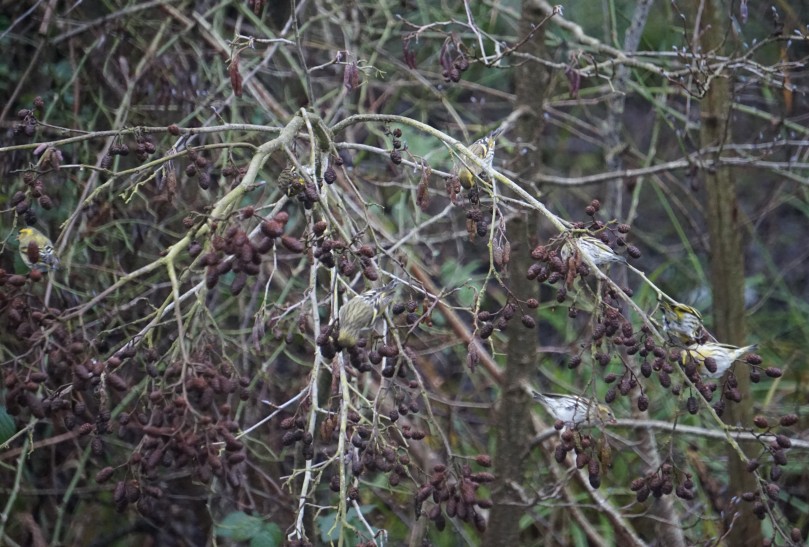
Fairlands Valley Lakes 15 January 2021.
 The History of the Birds of Stevenage