
Rare spring passage migrant, which formerly bred.
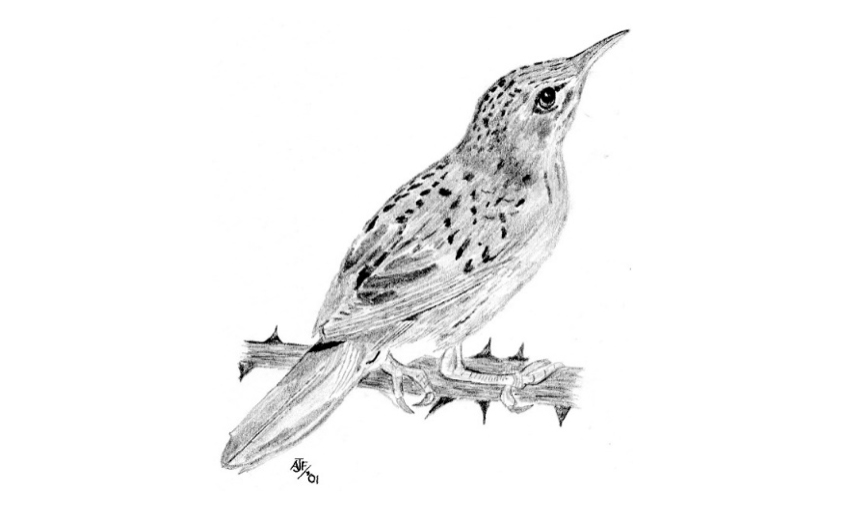
Between 1974 and 1999 the numbers of Grasshopper Warblers in Britain decreased by 79%, this has been due to habitat loss, the effects of the Sahel drought in Africa and changes in Britain’s spring and summer climate.
The 1973 Breeding Atlas considered breeding as probable from seven of the tetrads covering Stevenage, the 1992 Atlas considered breeding as probable from one tetrad and, possible from one tetrad, the 2012 Atlas did not consider breeding as possible.
The records for the 1960s and 1970s are: a male singing at Box Wood during the 1964 Breeding season; one heard, “reeling” at Box Wood on 2 May 1965; one at Box Wood on 13 and 26 May 1966; one at Watery Grove on 28 April, 20 and 25 May 1967; two at Watery Grove on 13 May 1967; one, “reeling in a cornfield next to Box Wood on 21 July 1967: one at Astonbury on 4 May 1968; one at Rockingham Way on 5 April 1968; one at Box Wood on 21 April 1969, and 22 September 1969; one heard in Monks Wood from 30 April to 19 May 1969; up to three heard at Box Wood on 23 April and 2 May 1970; one in song on the Railway Embankment near Bragbury End on 1 May 1971; one heard at Chells in 1972; a male heard, “reeling” in Box Wood on 29 April 1979, and a female ringed on 16 June 1979 and re-trapped on 17 July, breeding was suspected but not confirmed.
During the 1980s and 1990s the records were: one heard at Ridlins Mire on 10 May 1981; one at Watery Grove in 1984; one at Ridlins Mire during May and early June 1985; one heard at Broadwater in 1991.
They were not recorded again until 2008 when one was at Norton Green Tip on 20 April 2008. There have been four further records since then; one at Norton Green Tip in April 2013; one at an unrecorded location on 28 July 2015; one late summer 2016 at an unrecorded location; one at Goddard End on 25 August 2017.
 The History of the Birds of Stevenage