[BOBWHITE QUAIL (Colinus virginianus)]

During the nineteenth century numerous attempts were made to introduce this North American Game Bird to Britain. The majority of birds released lasted no more than two or three years, a few did survive for up to ten years. An old female was shot near Stevenage on 12 August 1882.

One was also found at Stevenage on 7 April 1967.

[ thought or known species of introduced or captive origin ]

QUAIL (Coturnix coturnix)

Rare summer visitor.

During the last quarter of the nineteenth century Quail were common as breeding birds in Hertfordshire. In 1902 Marlborough H. Pryor recorded that up to fifteen years previously Quail used to nest in the neighbourhood of Stevenage but were by then practically extinct in the area. Their decline nationally, which began at the end of the nineteenth century, has been linked to agricultural changes in Britain and the large numbers killed on migration in the Mediterranean.

One was shot at Aston End on 19 September 1893.

The other records are: one heard calling from rough ground reserved for building near Martins Wood on 5 July 1967; one calling at Aston on 7 June 1970; one heard calling as it flew over an unrecorded location at 2.30am on 25 July 1976; one heard calling at Bragbury End in June and early July 1989; a pair heard calling and seen near Norton Green on 30 and 31 May 1994; one heard calling west of Stevenage on the evening of 27 May 2003; one heard calling at Chells Green on 22 May 2004. (Chells Green was formerly a group of isolated cottages but is now part of the Hazel Park Development, Gresley Way).

RED LEGGED PARTRIDGE (Alectoris rufa)

Uncommon residents.

Red-Legged Partridges were introduced to Britain around 1770 by the Marquis of Hertford near Orford in Suffolk. By the last quarter of the nineteenth century following other introductions in Suffolk and Essex, they had spread throughout southeast England. The first record from Hertfordshire came from Little Almshoe near St. Ippollits in 1815. Although once common in the County there is now evidence to suggest they may be in decline.

The earliest record for Stevenage is from May 1891 when a nest with eggs was found on the ridge a straw stack at Aston.

The records from the 1960s and 1970s are: two pairs located at Aston End on 16 June 1963; six or seven at Box Wood on 30 January 1966; a pair at Box Wood on 8 April and 29 May 1966; five at Box Wood on 16 April 1967; Astonbury 3 March 1968; Holbrook Farm, Aston 31 March 1968; Fairlands Valley (occasionally seen 1969), Whomerley Wood (one in 1969); Fishers Green 1973; 10 by Watery Grove on 26 October 1973; a covey of 16 at an unrecorded location on 15 January 1974; eight by Symonds Green on 19 December 1974; two seen near Astonbury Wood and, two in the front drive of Astonbury Manor House on 10 April 1976; a pair and up to five birds Watery Grove spring 1977; breeding Astonbury 1977; a pair in fields adjoining Astonbury Wood in May 1978; an adult and 11 young seen on the drive of Astonbury Manor House on 2 July 1978 which took cover in a rose-bed; pair Watery Grove 1978; pair Box Wood 1979; covey of six Astonbury January 1979.

At Watery Grove one breeding territory was recorded by the Common Bird Census in 1977.

The records from the 1980s and 1990s are: pairs at Watery Grove and Box Wood 1981; coveys of 12 and 15 at Fishers Green on 4 December 1982; two at Box Wood on 24 April 1983; two at Norton Green Tip on 13 June 1983; Norton Green Tip 22 April 1990.

More recently the following large coveys have been seen: 17 near the River Beane at Aston End on 14 October 2010; 12 at Aston End on 15 October 2010; 13 at New Park Lane, Aston on 31 December 2010; 22 at Norton Green Tip on 23 October 2011; 12 at Watery Grove on 22 October 2013; 15 at Norton Green on 22 November 2015; 12 at New Park Lane, Aston on 26 September 2017; 12 at Lord’s Farm, Aston on 26 October 2018.

Confirmed as breeding from three of Stevenage’s tetrads by both the 1973 and 1992 Breeding Atlases, only probable breeding was considered by the 2012 Breeding Atlas from the tetrad covering Chesfield Park.

Successful breeding was recorded from Norton Green in 2020.

Their presence was confirmed in the tetrads covering Norton Green and Bragbury End by the 2012 Winter Atlas.

Red-legged Partridges can occur singly in unusual places, in the spring of 1972 one was encountered walking the wrong way around the roundabout by the Swimming Pool in heavy traffic, one was watched proceeding down Popple Way in March 1978 and, one was seen in a Fairview Road Garden on 1 July 2023.

The most recent local record is of one at Watery on 20 May 2025.

GREY PARTRIDGE (Perdix perdix)

Uncommon residents.

During the Nineteenth Century Grey Partridges were numbered in millions, in 2003 it was estimated that there were only 75,000 pairs in the Country. This decline has occurred during the twentieth century, becoming more noticeable after the Second World War and accelerating during the 1960’s. The decline has been attributed to the use of insecticides on cereal crops and the loss of suitable habitat. Chemical seed dressings were recognised as causing problems to Partridges as early as the 1840’s. The Herts Bird Club Grey Partridge Survey of 2005 estimated a reduction in population of 90% to 98% since 1992. During the survey two birds were found in the tetrad covering Norton Green, and four were found in the tetrad covering Boxbury Farm.  

In 1856 24 were shot at Aston End on 9 September, 55 shot at Broom Barns on 12 September and 17 shot at Monks Wood on 13 September.

The Game Book of Colonel Unwin-Heathcote of Shephalbury Manor records that 119 Partridge were shot at Shephalbury in 1893. From the same book: 30 were shot at Astonbury on 6 September 1893; two at Shackledell on 12 October 1893; 16 at Ridlins Wood on 22 November 1893; 29 at Aston End on 13 September 1894; 58 at the Monks Wood, “home beat” on 10 September 1895; and, 70 at Chesfield on 18 September 1895.

Records from the 1960’s 1970s are: a nest containing 10 eggs found near Mobbsbury, Chells on 23 June 1965; a pair at Mossbury on 24 April 1966; Box Wood on 29 May 1966; eight at Box Wood on 11 March 1967; Watery Grove 1967; a pair seen in Fairlands Valley on 14 May 1969; coveys of 15 and 20 at Bragbury End and, the Hertford Road area on 31 December 1973; six by Tilekiln Wood on 5 August 1974; pair Hertford Road 1974; a covey of 20 by Roebuck October 1975; two seen in the walled garden of Astonbury House on 16 April 1978; one at Astonbury on 9 May 1978; Astonbury 1979; 15 seen near Watery Grove on 19 October 1979; 10 in a field adjacent to Box Wood on 30 November 1979.

The records for the 1980s and 1990s are: pairs at Box Wood and Ridlins Mire in 1981; four at Box Wood on 25 January 1983; Norton Green 1983; 29 in two coveys at Norton Green on 6 January 1984; three pairs at Pryors Wood 1990; a covey of 28 seen in October and November 1992 at Norton Green; one at Watery Grove on 5 May 1993; two Holders Lane, Aston End on 7 May 1997; 12 at Bragbury End on 8 November 1997; Watton Road on 19 December 1998; Astonbury 13 February 1999; Norton Green Tip 9 April 1999.

More recently the largest coveys have been: Aston (14 between 20 December 2010, and 9 January 2011, 12 on 29 December 2021); near Astonbury (up to 12 between 21 and 25 October 2010); Aston End (12 on 2 November 2007, 25 October 2010 and, 16 October 2011); Bragbury End (12 on 4 January 2023); east of Chells Manor (12 on 2 December 2010); Norton Green (two coveys totaling 19 birds on 2 January 2008 and 12 on 22 December 2022); Watton Road, Bragbury End (15 on 2 January 2023); Potters Spring (20 on 18 August 2025).

The 1973 Breeding Atlas confirmed breeding from the tetrad covering Chesfield Park and considered breeding as probable from the other 10 tetrads covering Stevenage. The 1992 Breeding Atlas considered breeding as probable from five tetrads and, the 2012 Atlas from three.

Recent local breeding: An adult with four young at Norton Green Tip on 14 July 2014 and, an adult with seven young also seen there on 19 September, two adults and, chicks at Norton Green Tip on 16 July 2016, two adults and, approximately 10 nearly full grown birds at Chesfield Park on 26 July 2016, a covey of two adults and, five young at the rear of Lister Hospital on 3 August 2016, a covey of 10 birds at Norton Green Tip on 7 August 2017 which included juvenile birds, a single brood at Aston End in 2020 and c.10 birds including juveniles near Aston End Road on 27 July 2022.

The 2012 Winter Atlas recorded their presence from five of the tetrads covering Stevenage.

Unusual records are; a pair shot near Stevenage in 1886 by a Mr W. Garrett which had white wings and tails, a feature known as symmetrical albinism, a covey of eight seen in Rectory Lane on 10 November 2005 and one in an Edmonds Drive Garden on 20 October 2025.

The most recent local record is the Edmonds Drive bird on 20 October 2025

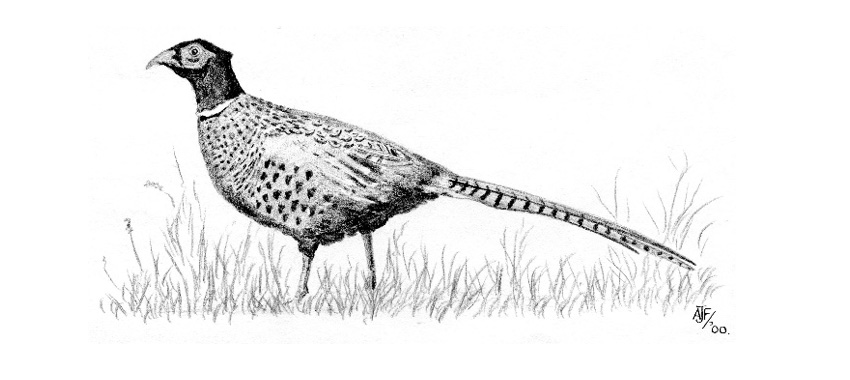
COMMON PHEASANT (Phasianus colchis)

Uncommon residents. 

Pheasants were formally reared in the Stevenage area for shooting, notably in the woodlands of the Knebworth House Estate, and “surplus” birds supplemented the feral population. 

The Game Book of Colonel Unwin-Heathcote of Shephalbury Manor records that 184 Pheasants were shot at Shephalbury in 1893. The same book records Pheasant Shooting between 1893 and 1895 from the following woods and, places, with the largest, “bags” in brackets: Aston End (15 on 30 November 1893); Chesfield (56 on 30 November 1895); Monks Wood (72 on 24 October 1893); Ridlins Wood (128 on 12 November 1895); Shackledell (23 on 23 September 1894) 

They can be found in any of the town’s woods, the surrounding farmland and occasionally in gardens. Single birds have been seen in Fairlands Valley in March 1975, and in 1976. In December 1979 one roosted in a small area of woodland surrounded by houses near Broadwater Crescent. A female was outside Hanger 1 at the BAE Factory in the winter of 1982. One was seen flying over the Town Centre on 6 November 1999.

At Fairlands Valley Lakes one was seen 24 February 2010, a female on 28 October 2019, a male on 27 December 2021 and a female on 26 August 2022.

30 were seen at Norton Green on 22 September 2016 and 1 November 2020. 

There is evidence of feral breeding at Ridlins Mire, on 9 July 1997 a female with two chicks was seen and, on 4 June 2006 a female and chicks were seen beside Gresley Way, near to Ridlins Mire.

The 2012 Winter Atlas confirmed their presence in seven of the tetrads covering Stevenage. 

At Watery Grove up to three breeding territories were recorded in the Common Bird Census between 1972 and 1999, these probably relate to surplus or surviving birds released in the Knebworth House Estate for shooting.  

[GOLDEN PHEASANT (Chrysolophus pictus)]

Commonly kept in collections, feral populations also exist in parts of Britain as a result of escapes and releases. Males have been seen at Chesfield in 1973, Watery Grove on 30 September 1974, and Oaks Cross on 1 April 1991.

[ thought or known species of introduced or captive origin ]