Feral Pigeons were confirmed as breeding in four of the tetrads covering Stevenage in the 1992 Breeding Atlas. The 2012 Atlas recorded probable breeding in two tetrads and, possible breeding in a further seven.
The 2012 Winter Atlas confirmed their presence from 10 of the tetrads covering Stevenage.
In 2015 in excess of 100 birds were reported from the Town Centre, 100 were reported from Stevenage on 29 October 2018 and, 18 December 2019, 146 on 10 December 2020 and, 200 on 26 November 2021.
Stock Doves were one of the hardest hit species from the effects of organochlorine seed dressings in the 1950’s, their numbers have since recovered.
In the 1960s and 1970s they were recorded from: Astonbury; Box Wood; Brooches Wood; Monks Wood; Tilekiln Wood; Watery Grove; Whomerley Wood.
During the 1980s and 1990s they were recorded from: Aston, Astonbury Wood; Box Wood; Norton Green; Watery Grove.
Since 2000 they have been recorded from: Abbots Grove; Ashtree Wood; Astonbury Wood; Aston End; Chesfield; Fairlands Valley Lakes; Holbrook Farm, Aston; New Wood, Aston End; Potters Spring.
The 1973 Breeding Atlas confirmed breeding from one of Stevenage’s tetrads, the 1992 Atlas confirmed breeding from five and the 2012 Atlas recorded probable breeding from three tetrads and, possible breeding from a further three.
Breeding was recorded from Fairlands Valley Park in 2021 and 2022.
The 2012 Winter Atlas confirmed their presence from the tetrads covering, Lister Hospital, Boxbury Farm and, Bragbury End.
The largest flocks recorded are, 70 at Box Wood on 16 February 1975, and 30 at Norton Green Tip on 13 June 1983. The most recent sizeable flock is 12 at Astonbury on 5 and 24 April 2003.
The Woodpigeon originally inhabited deciduous woodland and was in the nineteenth century considered as common in all the wooded and enclosed parts of Britain. By the last quarter of that century it was increasing and becoming more adaptable by breeding in more general habitats, this increase coincided with the growth of arable farming and the destruction of birds of prey and crows by gamekeepers which removed many of its natural predators. The downside of this increase was that the Woodpigeon became a pest because of the immense damage it does to arable crops. The Herts Express of 15 February 1957 advised Bedwell residents to keep out of Whomerley and Monks Wood for the next two or three Saturdays whilst Woodpigeon shooting took place under, “agricultural pest regulations”.
The 1992 Breeding Atlas confirmed breeding from all eleven of the tetrads covering Stevenage, this was an increase from the seven in the 1973 Atlas. This increase proved the adaptability of the Woodpigeon by increasing in an urban area and successfully making the transition from woodland and farmland to urban areas. The 2012 Breeding Atlas however, only confirmed breeding from 6 tetrads, probable breeding from 4 and, possible breeding from one tetrad.
The 2012 Winter Atlas confirmed their presence from all 11 of the tetrads covering Stevenage.
Breeding territories were recorded annually at Watery Grove by the Common Bird Census between 1984 and 1999, with a peak of 11 territories being held in 1998.
The largest flocks recorded are: 450 at Astonbury on 15 March 1967, 1,000 at Box Wood on 27 December 1973; between 500 and 1,000 at Coreys Mill on 31 December 1974; 1000 at Aston End on 1 December 2007; c. 840 over Fairlands Valley Lakes on 1 November 2021; c. 510 over Stevenage in flocks of up to 70 between 06.45and 07.30am on 2 November 2021; 1270 in flocks of up to 50 birds over Fairlands Valley Lakes on 6 November 2023; c.500 at Norton Green on an unknown date in 2023; 850 heading south over Fairlands Valley Lakes in groups of up to 70 on 24 October 2025.
The Collared Dove is a prime example of opportunistic exploitation. At the end of the nineteenth century it was only found in southern and central Asia. Its subsequent spread across Europe is one of the most dramatically successful colonisations of modern times. They were only first seen in Britain in 1952, and in Hertfordshire in 1957.
The earliest records from Stevenage are: pair at Humphreys End, Rectory Lane on 10 April 1966; one at the High Street on 1 October 1966; one at an unrecorded location on 1 January 1967; a pair in Monks Wood in 1969 (one of which was subsequently shot); two at Watery Grove on 11 April 1970; one at Monks Wood on 9 December 1971; three pairs Chells 1972; pairs Pound Avenue, Walkern Road, Fairlands Way and the Industrial Area 1972; pairs Aston End and Watery Grove 1973. From then their numbers built up with, 16 pairs recorded from Stevenage in 1973, and by 1976 they were considered common in the town.
Breeding was confirmed from eight of the town’s tetrads in the 1992 Breeding Atlas, which was an increase from the two in the 1973 Atlas. The 2012 Atlas confirmed breeding from two tetrads, probable breeding from five and, possible breeding from three tetrads.
The 2012 Winter Atlas confirmed their presence from all 11 of the tetrads covering Stevenage.
The Common Bird Census recorded their presence at Watery Grove in 1975, 1977, 1990 and 1993.
Approximately 50 were seen roosting at Lords Farm, Aston on 8 November 2003.
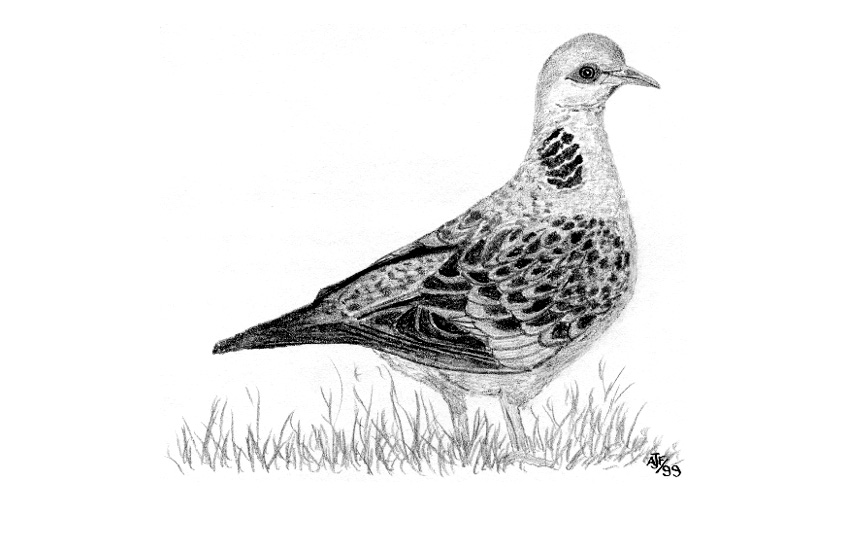
Turtle Doves were once common summer visitors to Britain, but have declined nationally by 96% since 1970, the reasons for this decline are, losses in their wintering range caused by the Sahel drought, shooting in Southern Europe during migration, agricultural changes in Britain and the intolerance of close Human pressure.
As an example of how common they once were, 40 were seen perched on wires near Stevenage on 3 July 1955.
The rapid decline locally is illustrated by the three Breeding Atlases. In the1973 Atlas breeding indications were recorded from 10 of the tetrads covering Stevenage, with breeding confirmed from the, Chesfield Park, Boxbury Farm, Norton Green and Aston tetrads. The 1992 Atlas recorded breeding indications from all 11 tetrads covering Stevenage, with breeding confirmed from the, Boxbury Farm, Pin Green and, Broadwater tetrads. No breeding indications were recorded by the 2012 Atlas for the tetrads covering Stevenage.
In the 1960s they were recorded from: Box Wood, Chesfield, Monks Wood and Whomerley Wood.
In 1972 they were described as widespread, but not uncommon at Stevenage. During the 1970s they were recorded from: Astonbury; Aston End; Box Wood (where a freshly fledged youngster was ringed on 23 September 1979); Monks Wood; Norton Green; Warren Springs; Watery Grove; Whomerley Wood.
The records for the 1980s are: Box Wood 30 April 1980 and, one ringed in September 1980; Astonbury on 7 May 1980; Roebuck 1980; 20 seen in June and July 1981 at Aston; Chells Manor and Watery Grove June and July 1981; one at Norton Green Tip on 13 June 1983; four at Box Wood on 1 May 1984; two at Box Wood on 5 May 1985; seen in Box Wood on 19 April 1986.
At Watery Grove where they were described as, “unusual visitors to the wood”. The Common Bird Census recorded their presence in 1972, 1977, 1978, 1987 and 1992.
The earliest arrival date was 12 April 1973 at Box Wood and, the latest departure date was 23 September 1978 also at Box Wood.
The records since the 1990s are: one seen flying over the Main Lake at Fairlands Valley Lakes in the evening of 19 May 2005; one on wires by the River Beane at Aston End on 9 June 2007; one in a Stevenage Garden on 21 and 26 July 2011; one at Norton Green Tip on 4 May 2012; one in an Old Town garden on 20 April 2018; one seen flying across the A1M south of junction 8 on 6 June 2018.

 The History of the Birds of Stevenage