WATER RAIL (Rallus aquatticus)

Rare winter visitor.

Water Rails are resident breeding birds in Hertfordshire and are also winter visitors from northeast Europe.

The earliest record for Stevenage is of an immature bird that was found exhausted in Broad Oak Way in 1972 (Stevenage Zoological and Wildlife Preservation Society Quarterly Members Journal Autumn 1972).

There are eleven records from Fairlands Valley Lakes: single birds seen between the Millennium and Environment Lakes on 18 and 19 December 2012, 7 and 8 April 2013, 9 March 2014 and, 17 March 2015; one seen in the Farmhouse Channel between 12 February and 23 March 2018; one at the Balancing Pond between 22 January and 31 March 2022 and, a second bird seen and heard at the Farmhouse Channel between 6 February and 1 April 2022; one at the Balancing Pond from 29 October 2022  to 1 March 2023; one at the balancing pond between 26 October 2023 and 19 March 2024; one seen in the Farmhouse Channel on 14 February 2024; one at the Balancing Pond between 4 December 2024 and 12 January 2025; one at the Environmental Lake on 30 and 31 December 2024; one at the Farmhouse Channel between 2 and 18 March 2025 (with two seen on 3 March); one seen and heard between the Millennium and Environmental Lakes from 2 and 25 November 2025; one seen and heard at the Balancing Pond on 19 and 28 December 2025.
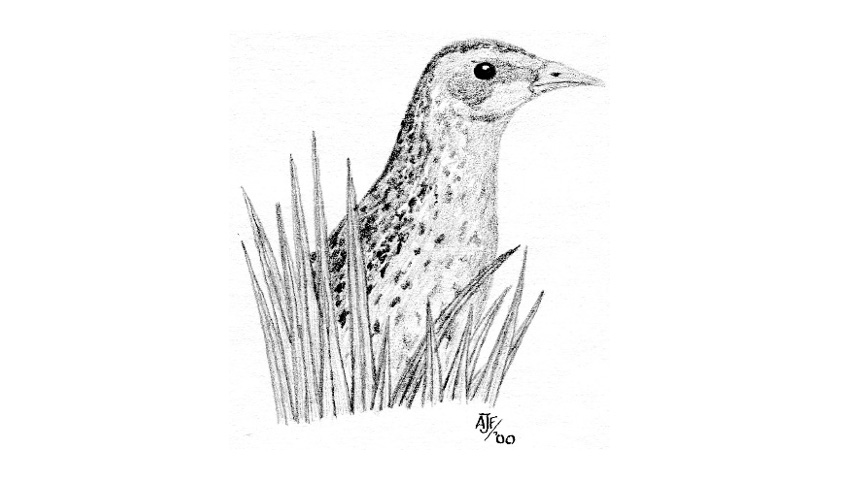
CORNCRAKE (Crex crex)

Former rare summer visitor.

The Corncrake is an endangered species in Britain and now only breeds in the western islands of Scotland and in Ireland. Their decline has largely been attributable to loss of suitable habitat, particularly hay meadows and the introduction of mechanized hay cutting.

In the nineteenth century the Corncrake was a common breeding bird in Hertfordshire, but rapidly declined from the beginning of the twentieth century. Foster (1914) referred to the Landrail (as it was formerly known) being, “frequently met with in fair numbers in autumn and is shot whilst Partridge shooting”. The Game Book of Colonel Unwin-Heathcote of Shephalbury Manor provides the following  records of them being shot whilst Partridge shooting: three at Chesfield on 16 September 1893; one at Aston End on 13 September 1894; one at Chesfield on 14 September 1895; three at Chesfield on 18 September 1895.    

Other records are; one shot Broom Barns on 29 September 1902, one heard calling at Stevenage on 4 May 1931, and one heard calling in a field at Shepalbury on 18 August 1939 by a Mrs Kerr.  A Corncrake was also believed to have nested near to Bedwell Plash around 1955/1956. 

MOORHEN (Gallinula chloropus)

Common breeding resident.

Described by Foster (1914) as, “Common everywhere and often very abundant wherever there is sufficient cover near water”.

Even as late as the 1980’s, Moorhens were persecuted by Gamekeepers.

Moorhens were confirmed as breeding in seven tetrads covering the town in the 1973 Breeding Atlas, all eleven in the 1992 Atlas and from seven in the 2012 Atlas.

The 2012 Winter Atlas confirmed their presence from nine of Stevenage’s tetrads.

Despite their familiarity today, they were still considered to be rare at Fairlands Valley Lakes in 1975. Two birds became established on the Islands at Fairlands Valley Lakes in 1976 but, they did not breed there until 1979. The first record from there is of two on 9 and 10 September 1974.

The largest number recorded at Fairlands Valley Lakes is 51 on 18 September 2016 and, 15 October 2016.

During the 2018 breeding season eight broods were recoded from Fairlands Valley Lakes.

In 2024 breeding was confirmed from Astonbury Wood.

Between 1972 and 1999 at least one breeding territory was recorded from Watery Grove by the Common Bird Census with, the exception of 1985 and 1991. Two territories were held in 1978, 1989 and 1995.

Known to perch in trees and bushes, one was seen in a Larch tree at Box Wood on 17 January 1965 and one was seen perched on top of a Fir Tree at Astonbury Wood on 5 February 1978.

Although Moorhens in Britain are sedentary, some are winter visitors from the Continent. A bird ringed at, Driehoek, Castricum, Noord-Holland, The Netherlands on 20 October 2002, was seen at Stevenage on 17 October 2008.

COOT (Fulica atra)

Breeding resident and winter visitor.

Coots were first recorded from Fairlands Valley Lakes in 1973 when up to three were seen between 4 and 31 December. Since 1993 they have successfully bred there, prior to which they were mainly winter visitors. Until 1998, when they remained all summer, brooding young into August, they gradually disperse following breeding during July and August, and increased in numbers again during the winter.  

The largest number recorded at Fairlands Valley Lakes is 56 on 21 August 2016.

Away from Fairlands Valley Lakes, two were found on some flood water near Box Wood on 15 January 1977 and one was at the Town Centre Gardens on 23 and 24 December 1981.