YELLOW WAGTAIL (Motacilla flava)

Uncommon passage migrant, which has bred.

In 1878 they were considered, to be scarce in Hertfordshire and, were described as not being common in the Stevenage district by Foster (1914).

Nationally since 1970 Yellow Wagtails have declined by 60% due to the loss of suitable breeding habitat.

They have been seen on spring and autumn migration at, Aston End, Astonbury Farm, Bragbury End, Chells Manor, Fairlands Valley and Lakes, Mobbsbury area of Chells, Norton Green Tip, Potters Spring, St Nicholas Park, Tilekiln Farm, Walkern Road and, Whomerley Wood (one seen by the Moat on 6 October 1974).

The largest flocks seen on migration are 12 at Fairlands Valley Lakes on 16 September 1996, 12 at St Nicholas Park on 20 September 2000 and 12 at Norton Green Tip on 1 September 2020.

The earliest spring arrival date at Stevenage is 25 March 2022 at Six Hills Way, and a late migrant was recorded from at the Moat in Whomerley Wood on 6 October 1974.

A pair bred at the old sewage works (now the Roaring Meg Retail Park) in 1966.

The 1973 Breeding Atlas considered breeding as possible from one tetrad covering the town, the 1992 Breeding Atlas considered breeding as possible from two tetrads and, the 2012 Breeding Atlas considered breeding as probable from the tetrad covering Chells Manor.

Recent summer and breeding records: Chesfield Park: breeding in 2013 and five seen on 24 August 2025; Fairlands Valley Lakes: one on 6 June 2022; Norton Green Tip: 14 juvenile birds seen on 17 June 2008, two birds seen on 14 and 29 July 2014 and an adult and three juveniles on 28 August 2014, one on 11 June and 25 June 2015 and, confirmed breeding that year with a juvenile seen on 21 July, one on 19 June 2016, three juveniles seen in a Cereal Field nearby on 15 August 2017, a juvenile seen on 26 June 2018, one flying over on 27 August 2022; the Bridle path between Bragbury End and, Knebworth: two seen on 1 June 2020; Potters Spring: single birds seen on 21 and 25 July 2017, four plus birds seen on 20 June 2022, single birds on 3 and 25 July 2022 and, two on 27 June 2023.
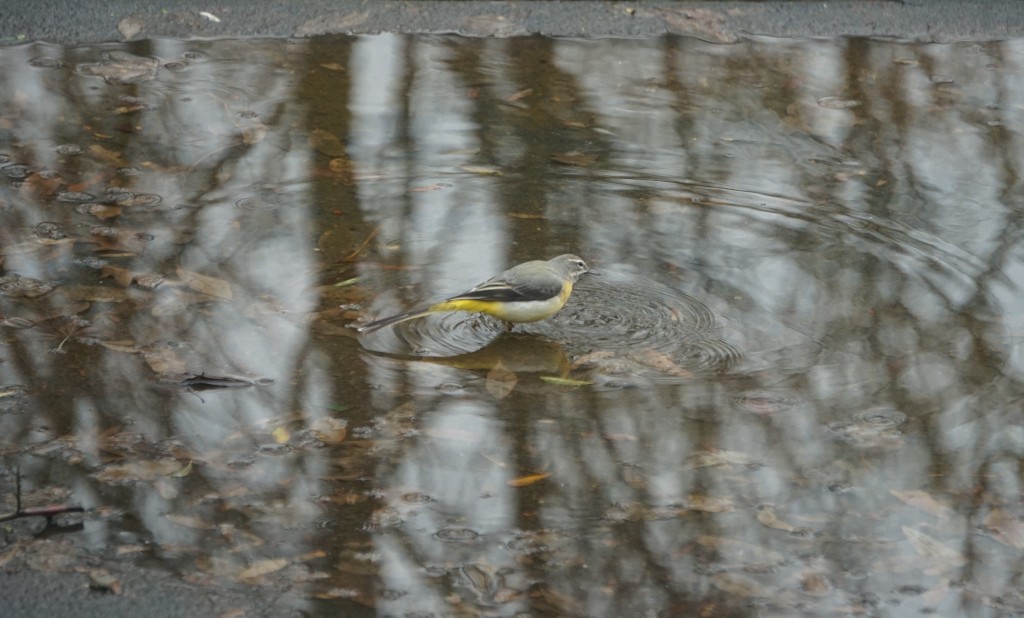
GREY WAGTAIL (Motacilla cinerea)

Passage migrant and winter visitor that has bred.

Foster (1914) recorded Grey Wagtails in the Stevenage district in winter.

They are regularly seen at Fairlands Valley Lakes, from where they were first recorded on 21 September 1974, with, records from every month of the year. The most seen together there are 20+ on 17 April 1981. Evidence of breeding has also recorded from there; juvenile birds seen on, 13 June 2003, and 22 June 2004, an adult and young seen on 16 June 2015, breeding confirmed in 2016, 2017 and 2019, a juvenile bird seen on 29 June 2020 and two adults, and a juvenile bird seen on 16 June 2023.

Other records for Stevenage:

Prior to 1990: Bragbury End 1973; Whomerly Wood, Industrial Area and Town Centre Gardens 1975; one at Town Centre Gardens on 12 January 1976; two at Watery Grove on 10 July 1977; Town Centre Gardens 1977; Astonbury 3 September 1978; a ringed bird caught in Box Wood 23 September 1978; male at Astonbury 26 November 1978; one at Astonbury 2 January 1979; Stevenage Golf Course 1 November 1979; Watery Grove during the 1979 breeding season; Watery Grove April and 18 and 26 June 1980; one at Glebe Shops 15 October 1980.

The 1990s: one at Edmonds Drive on 2 October 1993; Aston Brook 15 October 1995; Ditchmore Lane 29 November 1996; Stevenage Brook, Monks Wood Way 23 December 1996.

Between 2000 and 2009: Town Centre Gardens 11 March 2003 and 27 April 2005; Bessemer Drive 23 January 2006; Brickdale House 9 February 2006; Gunnels Wood Road 16 September 2006; two Bedwell Crecent 7 November 2006; Asda Car Park 19 May 2007; Ridlins Mire 25 November 2007; Ridlins End 20 July 2008; Stevenage Brook, London Road 20 and 21 January and 30 July 2009; Towers Pond 7 May 2009; Town Centre Gardens 21 May 2009; Aston Brook, Gresley Way 20 December 2009.

With an increase in records between 2010 and 2019 they were recorded from: Aston Brook, Goddard End and Gresley Way; The Coach House, Bragbury End; Broadwater Crescent; Jackdaw Close; Leisure Park; Old Town; Norton Green Pond and the Pond behind Norton Green Cottage; Norton Green Tip; Ridlins Mire; St George’s Church; Six Hills Way; Southgate; Tatlers Lane, Aston End; Town Centre and Town Centre Gardens; Watery Grove.

Since 2020 they have been recorded from: Astonbury; Astonbury Wood; Aston End Road; roof of the former BHS Store, Town Centre; Broadwater; Chells Manor and Pond; Edmonds Drive; Pin Green; Potters Spring; Sandown Road; Six Hills Way; Stevenage Brook; Town Centre Gardens; Watery Grove.          

They were not recorded as breeding in the 1973 Breeding Atlas at Stevenage, the 1992 Breeding Atlas considered possible breeding from the tetrads covering Pin Green (which includes Fairlands Valley Lakes), Broadwater and Norton Green, the 2012 Atlas confirmed breeding from the tetrad covering Knebworth and, considered possible breeding from the tetrads covering Pin Gren and Norton Green and possible breeding from the Old Town, Broadwater, and Aston.

In 2014 birds were seen carrying food at Watery Grove on 10 May and, at Southgate Car Park on 22 June. In 2016 a pair were seen carrying food at the Town Centre Gardens on 5 May. In 2019 Breeding was suspected at Watery Grove.

The 2012 Winter Atlas confirmed their presence from eight of the tetrads covering Stevenage.

PIED WAGTAIL (Motacilla alba)

Common resident, passage migrant and winter visitor.

Regularly seen at the Town Centre, the Industrial Area, Gresley Way and Fairlands Valley Lakes.

They were confirmed as breeding in five of the town’s tetrads in the 1973 Breeding Atlas, from nine in the 1992 Atlas and, from five in the 2012 Atlas.

Outside of the breeding season they form large communal roosts, often in shrubberies and at man – made structures: in 1965 30 roosted in a hangar at the BAC Works (MBDA), Gunnels Wood Road and, the birds were frequently seen indoors in hard weather; 200 were seen roosting in Monks Wood during November 1969; between 1974 and 1979 up to 400 roosted at the Lister Hospital.

A flock of over 50 birds were seen in a field adjoining the western boundary of Norton Green Tip on 26 January 2015 and, a pre-roost gathering of 88 birds was seen at an unrecorded location on 21 January 2017.

Pied Wagtails are vulnerable to severe winter weather, and huge losses occurred in the winter of 1962/63.

The 2012 Winter Atlas confirmed their presence from 10 of the tetrads covering Stevenage.

Two unusual records: 19 were seen following a plough near Astonbury on 24 March 1973; in 1975 a pair nested in a well at Astonbury.

There are seven records of the continental race, “White” Wagtail (M. a. alba); two from Fairlands Valley Lakes on 20 April 1990 and 17 April 1991 and, Norton Green Tip; one on 14 April 2005; two on 12 April 2012, one on 4 April 2013, one on 9 April 2013 and two on 30 April 2013.

TREE PIPIT (Anthus trivialis)

Rare passage migrant and former summer visitor.

From the nineteenth century until the 1960s Tree Pipits were common and widely distributed in Hertfordshire but have since declined rapidly. This decline is attributed to habitat changes, such as coppiced woodland becoming overgrown, and the maturing of conifer plantations, which does not suit their need for open woodland.

The 1973 Breeding Atlas confirmed breeding from the tetrad covering Norton Green and, as probable from the tetrad covering Boxbury Farm. Neither the 1992 or 2012 Atlases recorded any breeding activity.

The records for Stevenage are: three singing males Box Wood 1964; recorded from Box Wood 1965; recorded from Box Wood and Monks Wood 1966; one Box Wood on 17 April 1967; one Box Wood on 24 April and 2 May 1970; a bird in song Box Wood on 12 May 1971; one Box Wood on 7 May 1972 and, one feeding young  Watery Grove on 7 June 1972; two different pairs Watery Grove in May and June 1973; two Watery Grove during April, May and, July 1974; birds seen Box Wood and, Watery Grove 1975; a pair Box Wood 1978, two seen at Box Wood on 12 May 1979 and three the following day which were seen displaying and one carrying nesting material; a male displaying Box Wood on 25 May 1981; one seen Box Wood on 30 August 1984; one at Norton Green Tip on 10 September 2018.

The most recent record is of one on migration at Norton Green Tip on 4 September 2020.  

MEADOW PIPIT (Anthus pratensis)

Passage migrant, and winter visitor, which has bred.

Foster (1914) recorded that Meadow Pipits were found on high ground near Stevenage, and in Hine (1934), he recorded that, “In the winter almost every low lying waste place seem to contain Meadow Pipits; the sewage farms at Hitchin, Sevenage and Baldock seem sometimes to be alive with them.” 

Sage (1959) stated that their main breeding areas in Hertfordshire was on the high ground running from Stevenage to Royston.

The 1973 Breeding Atlas confirmed breeding from the tetrad covering Pin Green, but were not confirmed as breeding in Stevenage in the 1992 and 2012 Atlases. Birds were seen at Broaches Mead, Great Ashby, prior to its development in June 2000 and 2001.

Passage birds have been seen at, Astonbury, Box Wood, Chells, Fairlands Valley and Lakes, New Park Lane, Aston, Norton Green Tip, Stanley Road and, Warren Spring. The largest number seen in spring is, 50 roosting at Box Wood on 31 March 1967 and, 36 at Fairlands Valley on 31 March 1973. The most seen in autumn is 37 at New Park Lane, Aston on 28 November 2012.

The 2012 Winter Atlas confirmed their presence from the tetrads covering Boxbury Farm, Pin Green, Broadwater and, Aston.

Since 2012 wintering birds have been seen at, Astonbury, Astonbury Farm, Aston End Road, Aston Recreation Ground, Lords Farm, Aston End, New Park Lane, Aston, Norton Green Tip, Potters Spring and, near the River Beane, Aston.