WRYNECK (Jynx torquilla)

Rare passage migrant, mainly in the autumn and, former summer visitor.

Wrynecks were formerly common summer visitors to Britain but are now only uncommon autumn migrants. The cause of their decline, which began in 1900, and loss as a breeding species has not been established, loss of old pasture has been suggested.

In Hertfordshire they were common as a breeding species in the nineteenth century. Foster (1914) recorded that the Wryneck, “occurs regularly in all parts of the district as a summer visitor but appears to be less common than formerly”. By 1935 they were considered as scarce in the County, and Sage (1959) described them as, “local in extreme, if not extinct except as a migrant”. The last confirmed breeding in the County was at Ringshall near Little Gaddesdon in 1977. In July of that year an adult was also seen feeding a juvenile near Stevenage, which could also be considered as possible evidence of local breeding.

Other records for Stevenage are of one on 29 September 1968, one seen for 20 minutes in the garden of 42 Rockingham Way on 29 August 1970, one seen feeding on the ground at Bessemer Drive in September 1981 and, single birds at Norton Green Tip on 12 September 2005, from 2 to 5 September 2015, and, 7 and 8 September 2016. 

The one spring record is of one in a Tates Way garden on 1 May 2011.
GREEN WOODPECKER (Picus viridus)

Fairly common resident.

In the nineteenth century Green Woodpeckers were uncommon as breeding birds in Hertfordshire. At that time, they were also persecuted by Game Keepers.

Foster (1914) recorded that they had been seen at Stevenage.

Not confirmed as breeding at Stevenage by the 1973 Breeding Atlas, they remained an uncommon Bird in North Hertfordshire until the late 1980’s.

The records for the 1960s and 1970s are: Heard at Astonbury 26 May 1966; seen in a Lodge Way Garden 22 December 1966; Astonbury Park 15 March 1967; heard Shephalbury Park 27 April 1967; Astonbury 8 April and 11 May 1968, January to May 1969; Watery Grove 17 April and 27 May 1971, 10 December 1972; Astonbury 31 March and 17 June 1973, 19 and 21 January, 11 May 1974; three Hertford Road Area 1974; Watery Grove 2 March 1976; Astonbury 1977, 1978, 1979; Watery Grove 1979; Box Wood 1979; Fairlands Valley 1979.

The only records for the 1980s came from Box Wood 1981, 11 May 1985, 12 and 19 April 1986.

During the 1990s they were recorded from: Ashtree Wood, Aston, Astonbury Wood, Aston End, Edmonds Drive, Fairlands Valley Lakes, Gresley Way, Monks Wood, Norton Green Tip, Watery Grove, Whomerley Wood, Wiltshire Spring.

Since 2000 they have been recorded from: Ashtree Wood, Aston, Astonbury Wood, Aston End, Bragbury End, Collenswood, Edmonds Drive, Fairlands Valley Lakes, Great Ashby Park, Gresley Way; High Broomin Wood, Monks Wood, Norton Green Tip; Pryors Wood, Ridlins Mire, Symonds Green, The Avenue, Watery Grove, Whomerley Wood, Wiltshire Spring.

The 1992 Breeding Atlas confirmed breeding from the tetrad covering Box Wood, the 2012 Atlas confirmed breeding from four tetrads (Boxbury Farm, Norton Green, Aston, Bragbury End).

Recently fledged young have been seen at: Aston 2024; Aston End 2020; Fairlands Valley 2015, 2017, 2018, 2019, 2022 and 2023; Norton Green Tip 2015, 2016, 2018 and 2020.

The 2012 Winter Atlas confirmed their presence from nine of the tetrads covering Stevenage.

The most seen together are five at Norton Green Tip on 27 September 2008.

At Watery Grove the Common Bird Census recorded one breeding territory being held in 1973, but did not record them again until 1991. From 1991 to 1999 their presence was recorded during the breeding season, with one breeding territory held in 1994 and 1999.

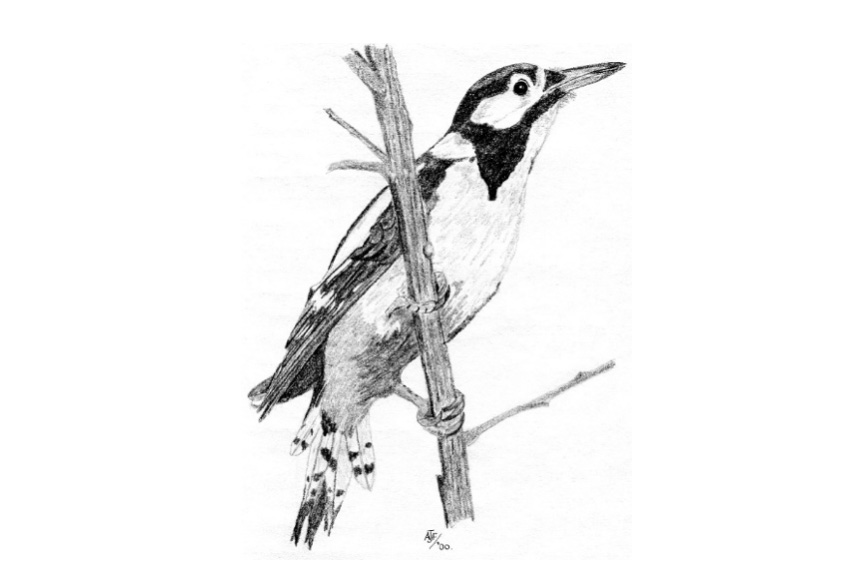
GREAT SPOTTED WOODPECKER (Dendrocopos major)

Common woodland resident.

In the nineteenth century the Great Spotted Woodpecker was a rare breeding species in Hertfordshire. Foster (1914) described it as, “the scarcest of the Woodpeckers”, recording that they were found at Box Wood and Whitney Wood. The Stevenage Woodland Conservation Society recorded in 1969 that Great Spotted Woodpeckers did not nest in Whomerley Wood due to lack of nest sites. The increase noted since 1970 has been linked to woodland in Hertfordshire no longer being intensively managed and holding increased amounts of dead wood which suits it’s needs.

The increase in their numbers may be having an adverse, effect on other bird species, as they are known to predate nests of other species, particularly tits. There is also a known instance in the County where a nest of a Lesser Spotted Woodpecker (Dendrocopus minor) was predated.

Great Spotted Woodpeckers were confirmed as breeding in five of Stevenage’s tetrads in both the 1992 and 2012 Breeding Atlases, an increase from three in the 1973 Atlas.

Recent breeding activity: two nests found in Box Wood in 2020; confirmed breeding at Fairlands Valley Park in 2022. Recently fledged young seen at: Box Wood 2024; Chells Manor 2016; Aston Allotments 2018; Fairlands Park 2019; Norton Green 2019; Long Lane, Aston End 2020; Fairlands Valley Park 2023 and 2024; Astobury Wood 2024; An adult seen feeding a juvenile at Edmonds Drive in June 2024 and 2025.

The earliest, “drumming” was recoded at Fairlands Valley Park on 31 December 2021.

The 2012 Winter Atlas confirmed their presence from 10 of the tetrads covering Stevenage.

The most seen together are six at Astonbury Wood on 13 November 1983.

Three unusual records; in 1965 a Great Spotted Woodpecker’s nest box in Box Wood was taken over by Tree Sparrows (Passer montanus), one seen perched on a Dahlia Cane at Aston Allotments on 16 September 2011 and, one seen and heard drumming on a TV aerial on 21 April 2016

At Watery Grove the Common Bird Census recorded them holding breeding territories between 1978 and 1999, and they have probably bred there annually since 1980.

Five adults and a juvenile were ringed in Box Wood in 1979.

LESSER SPOTTED WOODPECKER (Dendrocopos minor)

Scarce and declining residents.

The Lesser Spotted Woodpecker was an uncommon breeding bird in Hertfordshire during the nineteenth century. Foster (1914) claimed that they were fairly common in woods near Stevenage. Having declined by 83% between 1970 and 2015, their numbers nationally are now giving concern.

In the 1973 Breeding Atlas they were confirmed as breeding in two of Stevenage’s tetrads, probable breeding from seven tetrads in the 1992 Atlas and, only possible breeding from two tetrads in the 2012 Atlas. 

They formerly bred at, Astonbury Wood (last recorded on 26 April 2010), Box Wood (last recorded on 11 May 1985) and, Watery Grove, where despite being recorded by the Common Bird Census as being present during the 1981, 1989, 1995, 1997 and 1999 breeding seasons, they have never been more than occasional visitors to the wood (last recorded on 3 February 2000). They have also been seen in Monks Wood (last record 9 April 2022), Parsonsgreen Wood, Great Ashby (one record 4 December 2014), Pryors Wood (last record 16 April 2013), Ridlins Wood (last record 17 April 1999) and, Whomerly Wood (last record 1975).

Away from the woodlands they have been seen at: Chells on 5 July 1970, 1972 (young birds being fed July) and 1974; Pin Green 1974; Aston End 1975; the Industrial Area 1980; Sish Lane 1981; male(s), “drumming” at Shephalbury Park 1988, one in the London Road between Brickdale House and Tesco’s Car Park in the springs of 1988 and 1989; one at Chesfield Park on 28 March 1989; one at Great Ashby on 16 November 2007; female in a Great Ashby Garden on 19 May 2020; one at Fairlands Valley Park on 18 March 2022.

The 2012 Winter Atlas confirmed their presence from the tetrad covering Norton Green.

The most recent record is of one at Monks Wood on 9 April 2022.