
Uncommon passage migrant and winter visitor that has bred.
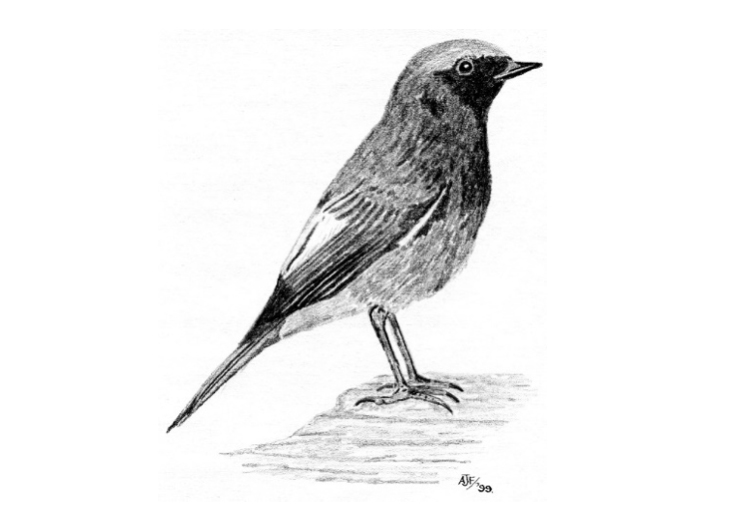
Black Redstarts are scarce as breeding birds in Britain and are only recent colonizers of the country. Their northward spread from southern Europe had begun in the nineteenth century, and they were first recorded as breeding in Britain in 1923. Although they are birds of rocky mountainous areas with bolder strewn scree, they are in Britain associated with industrial wasteland and buildings, particularly rambling commercial structures.
In 1975 and 1976 a pair successfully bred at the now demolished Warren Springs Laboratory, five fledged young were seen on 22 July 1976. A female was seen at this site in May 1977. A pair were also seen on 15 and 19 August 1991, at this time Warren Springs was being redeveloped by Glaxo, but some of the old laboratory buildings had still to be demolished. Breeding was confirmed again in 1993, and the following observations by John Melling were published in the 1993 Hertfordshire Bird Report. “The pair nested at the same site last used in 1976, underneath a metal stairway about 3.5m above ground level. Hatching took place on or about 11 June and fledging around the 28. Up to four young were seen thereafter with two still present on 19 August. The parents were unobtrusive before hatching but the male sang regularly from 27 July until 19 August. Only the male was seen from the 24 August with the plumage becoming more developed. Although seen on only four days in September sightings were more frequent in October with singing last heard on the 13 September plus a final sighting on 1 November.” In 1994 a pair were reported to have raised one young on a construction site, and it is assumed that this was also at the Glaxo site. Males were also seen at this site on 25 February 1996 and 10 June 1997. Possible breeding was also recorded from Stevenage in 1974, and whether this was also at this site is not known.
Other records for Stevenage are:
One at an unrecorded garden April 1973; two females observed for 30 minutes outside the Bakery in Cartwright Road on 21 October 1973; two at Watery Grove on 6 April 1974; a pair at an unrecorded location for three days in April 1978; a singing male at Box Wood on 8 and 9 April 1979.
A female behind Box Wood on 7 May 1980; one at an unrecorded location on 4 April 1984 and a pair in early May; one at Pin Green on 14 March 1989.
Male Norton Green on 23 March 1992; female Edmonds Drive on 6 April 1994; one at an unrecorded location on 16 December 1996; male at an unrecorded location on 10 June 1997; one at an unrecorded location on 22 January 1998.
A male at an unrecorded location on 19 April 2000; one in a Garden on 5 January 2003; female at Norton Green Tip on 12 May 2004; female at Norton Green Tip on 14 April and 11 May 2005; female in a Great Ashby Garden on 23 October 2006; one at Norton Green on 19 April 2008.
One near the Six Hills on 26 October 2011; first summer male on 18 March and a female on 19 March 2012 at Norton Green Tip; female at Argyle Way on 31 October 2012; one at Norton Green Tip from 15 to 27 April 2013; female at Norton Green Tip on 24 April 2014; one at Norton Green Tip on 31 March and 17 April 2016; female in an Aston Garden on 25 and 26 March 2020.
One at an unrecorded location on 10 April 2021; female in a Jackdaw Close Garden on 6 April 2023; one in Great Ashby Way on 1 November 2025.

