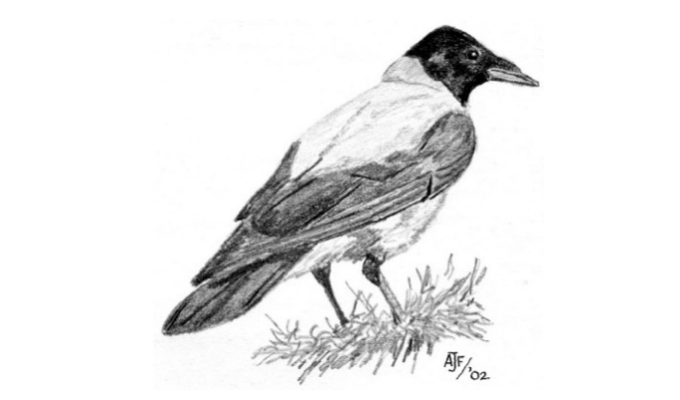
MAGPIE (Pica pica)

Abundant resident.  

Magpies are successful birds, which have survived differing Human attitudes towards them. In the nineteenth century they were persecuted by gamekeepers, farmers and gardeners, because of, superstition, and their reputation for raiding the nests of other bird species, and destroying their eggs and young. 

The reduction of Magpie numbers in Britain by the end of the nineteenth century was so severe that some writers of the time were contemplating its extinction in some areas. Described as “extinct” around Hitchin in 1877, A. F. Crossman wrote in 1902 that Magpies were, “a thing of the past in most parts of Hertfordshire.” In 1908 they were also said to be rare at Stevenage.

Magpies began increasing again in southern and eastern England in the 1930s, and during the 1940s the increase was considerable, at this time there was also an expansion of birds from the countryside into the towns. Between 1967 and 1999 they increased by 107%.

Although the increase in Hertfordshire had begun after the First World War, Sage (1959) described Magpies as, “still rather scarce at Stevenage”. The first modern records for Stevenage are, two at Box Wood on 16 October 1965, a pair nest building in Ashdown Road in February and March 1966, single birds at, Chesfield Manor, Box Wood, Hertford Road, Newgate and three at Astonbury Wood in 1967, and a pair at Astonbury Wood on 23 February 1969.

Whilst the 1973 Breeding Atlas confirmed breeding from the tetrads covering Aston, Knebworth and Bragbury End in 1973 they were considered uncommon, with only one pair being seen that year in Fairlands Valley near Monks Wood. Further pairs were recorded in the 1970s at Astonbury (where they bred in 1976 and 1977), Box Wood, Collenswood School, and Watery Grove. In 1980 no nesting was recorded at Stevenage. Since then, they have increased dramatically and are today very common residents of Stevenage.

The 1992 Breeding Atlas confirmed breeding from every tetrad covering Stevenage, the 2012 Atlas from eight.

11 nests were found in Fairlands Valley Park in 2021 and eight in 2022.

The Common Bird Census at Watery Grove did not record them during the breeding season until 1985, when a single territory was held. From then until 1999 they have annually held one or two breeding territories, with the exception of 1986, 1988 and 1996 when only their presence was recorded.

The 2012 Winter Atlas confirmed their presence from all 11 of the tetrads covering Stevenage.

The following large flocks have been recorded: 41 birds in Fairlands Valley on 12 January 2002, 36 at an unrecorded location in 2011, 64 at a roost site at Warren Spring Laboratory on 21 February 2015, 51 birds in Fairlands Valley on 6 October 2019, 40 birds in Fairlands Valley Park on 19 January 2021 and 48 at Fairlands Farmhouse on 30 December 2022.
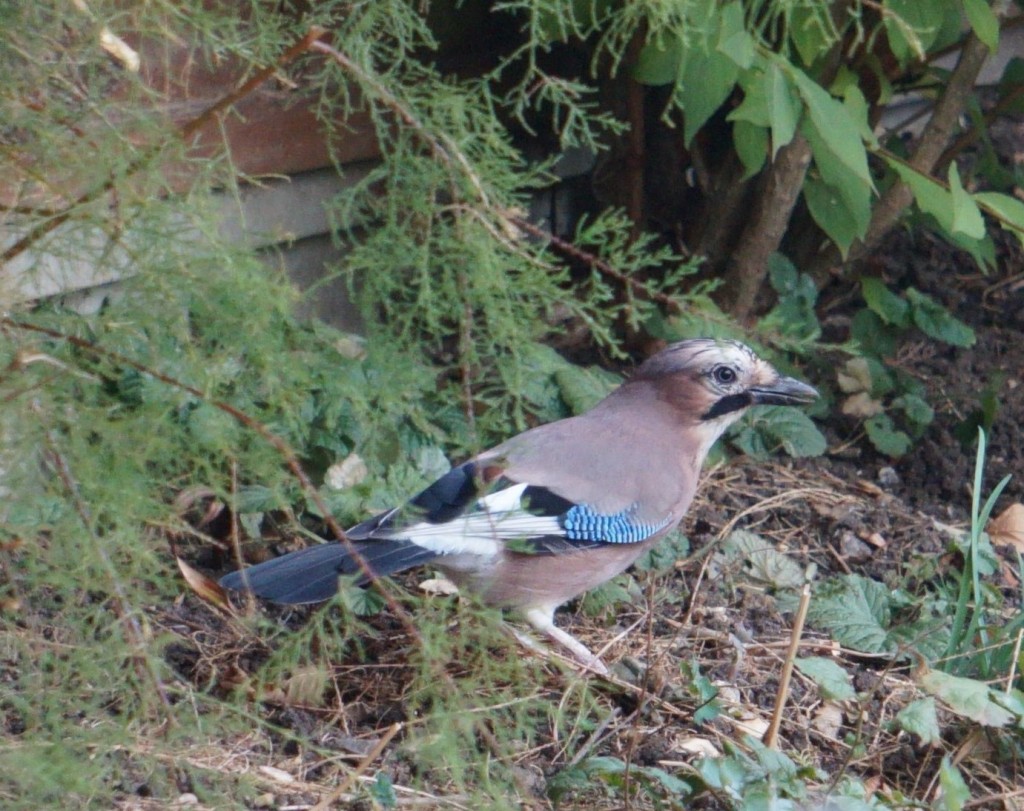
JAY (Garrulus glandarius)

Resident and winter visitor in small numbers.

In the nineteenth century Jays were persecuted by, gamekeepers and farmers. They were also shot for their feathers, which were used in the fashion industry, and the blue feathers of their wing coverts used as fishing flies. On 21 February 1968 nine were shot in the Knebworth House Estate and adjoining woods during a shoot to reduce Muntjac Deer (Muntiacus reevesi), and in 1979 some were found on a Gamekeepers’ gibbet by Astonbury. 

Uncommon as breeding birds in Hertfordshire during the nineteenth century, Foster (1914) described them as, “common in woods near Stevenage”.

The 1973 Breeding Atlas confirmed breeding from four of Stevenage’s tetrads, the 1992 Atlas from five but, from none by the 2012 Atlas.

The Common Bird Census at Watery Grove recorded them annually between 1972 and 1999 as either being present during the breeding season or holding single territories with, the exception of 1996 when two territories were held.

Breeding was confirmed from Astonbury Wood in 2024.

The 2012 Winter Atlas confirmed their presence from all 11 of the tetrads covering Stevenage.

Jays are prone to occasional irruptions, which may be linked to the failure of the Acorn crop either in Britain or on the continent. In 1882 there was a large immigration of Jays into Hertfordshire. 100 years later in the autumn of 1983 during a notable irruption of Jays into southern Britain the highest count in Hertfordshire was the 40 to 50 flying south over Stevenage on the morning of 4 October.

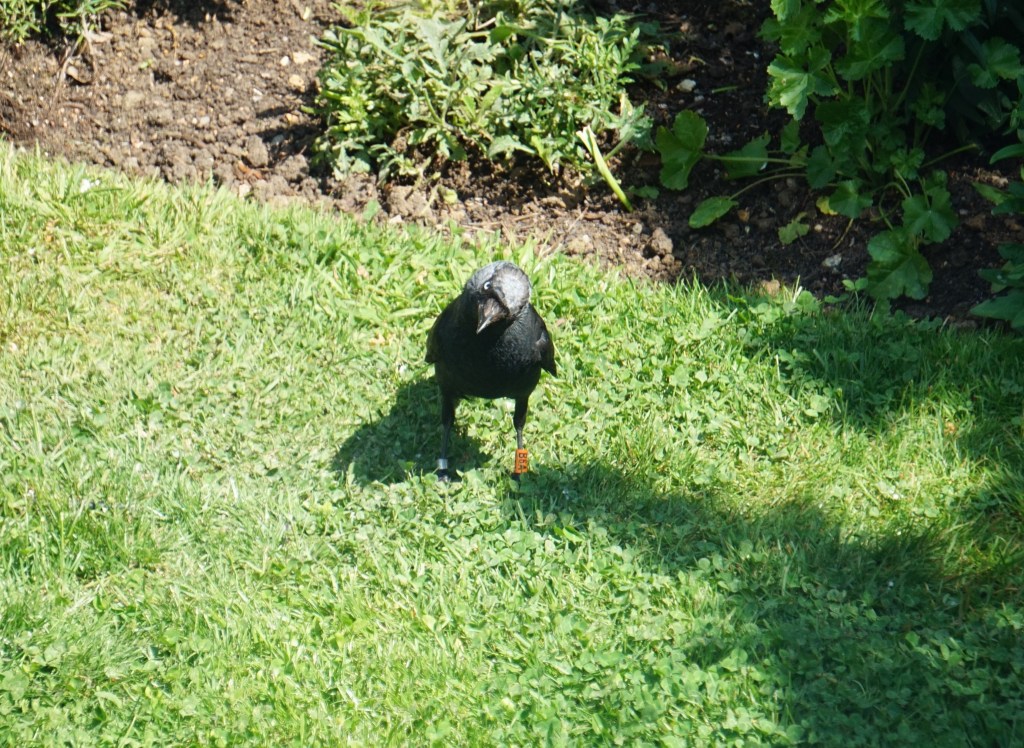
Jackdaw Close October 2018

JACKDAW (Corvus monedula)

Fairly common residents.

Jackdaws suffered less persecution than other members of the Crow family during the nineteenth century and, were at that time considered common as breeding birds in Hertfordshire.

Large numbers of Jackdaws, Rooks and Carrion Crows gather and roost in Fairlands Valley in the evenings. The largest flocks of Jackdaws seen there are 950 on 6 February 2017 and 1000 on 9 December 2023. 1000 were also seen at the adjoining Monks Wood on 29 November 2024.

A flock of 65 was seen at Chells on 3 December 1972 and, 320 were at an unrecorded location on 25 February 2015.

The 1973 Breeding Atlas confirmed breeding from eight of Stevenage’s tetrads, the 1992 Atlas from 10 and, the 2012 Atlas from four.

The Common Bird Census at Watery Grove recorded them as holding two territories in the 1990 breeding season, and as being present in the 1993 and 1998 seasons.

Young birds were seen at Astonbury Wood in 2024 indicating breeding in the wood.

A bird with a coloured ring B6A that was ringed at Benington on 11 June 2021 as at least two years old was seen in an Edmonds Drive Garden on 10 June 2025.

The 2012 Winter Atlas confirmed their presence from all 11 of the tetrads covering Stevenage.

Ringed bird B6A

ROOK (Corvus frugilegus)

Fairly common resident with former rookeries recently being re-established. 

Although Rooks consume great quantities of agricultural pests, they have always been regarded as pests especially on newly sown or ripening cereal crops, and for this reason have been “scared off” and where possible killed.

Rooks expanded their range in Britain during the eighteenth and early nineteenth Centuries, and their numbers were still increasing until around 1960 when there was a sudden sharp decrease due to the use of toxic chemicals in seed dressings.

Despite the loss of agricultural land as Stevenage developed rookeries have continued to exist within the town and surrounding countryside. Some are large and well-established others are small and may only exist for a short time.

In 1960/61 there were eight rookeries in Stevenage.

In 1971 rookeries were recorded at: Aston (Stringers Lane), Aston End (Lord’s Farm and New Wood), the Avenue, Bragbury End (three sites, one east of the Railway, one beside the A602 and one opposite the Chequers Pub), Chells (Six Acre Wood), Chesfield (Harbourclose Wood at Manor Farm, two sites), Frobisher Drive, Marymead, Monkswood Way (in the grounds of the former college, now Asda), Rectory Lane, the Town Centre (Swingate Car Park and behind the Towers). The largest rookeries were at the Avenue (90 nests) and Rectory Lane (59 nests).

In 1975 17 rookeries were recorded in Stevenage and 10 in 1993. In the surveys of rookeries from 1975 and 1993 three were present in the same locations, Round Wood, Chesfield, Manor Farm, Chesfield and, Roebuck Vets.

The large rookeries in the Avenue and at Rectory Lane had gone by 1975 but, were being re-established in 2005.

In 2013, 34 nests were recorded from a rookery at Warren Springs Laboratory on 21 February.

Since 2014 rookeries have been recorded (with active years) at: Ashburnham Walk (two sites 2016 to 2022); the Avenue, Martins Way (2014 to 2022), Bragbury End (2014 to 2022); Broadhall Way, near Greenside School (2015); Broadwater Crescent/Nokeside (2014) Broadwater Road (2014 to 2018); Claypit Hill Spring (2021); Fairlands Valley Park, north end (2015); Fairlands Way/Grace Way (2015, 2018, 2019); Farnham House, Gunnels Wood Road (2019); Fishers Green Road/Lymington Road (2014 and 2021); Fishers Green adjoining the A1M (2015); Grace Way (2019); Gresley Way (2014 to 2016); Hampson Park, adjoining Meredith Road (2015); Hampson Park (2015 to 2017); Holders, Aston End (2014 to 2022); Kimbolton Crescent (2022); Ledgefield Plantation, Chesfield (2014 to 2018); the Leisure Park (2022), Long Leaves (2021 and 2022); Manor Farm, Chesfield (2014, 2016, 2017); Moss Bury School (2015); New Wood, Aston End (2014 to 2022); Roebuck Retail Park, north (2014 and 2015); Roebuck Vets, Roebuck Gate (2018 to 2022); Round Wood, Chesfield (2014 to 2018); Sishes Wood (2016 and 2022); Stevenage Golf Course (2014 to 2021); Tesco Roundabout, Lytton Way (2020 to 2022); Vardon Road/Hobbs Court (2014); Vardon Road (2020 to 2022).

The largest number of nests recorded in a rookery is 53 at New Wood, Aston End in 2021.

In 1974 the following large flocks were recorded at Stevenage; 200 along the Hertford Road on 23 March, 91 in fields at Botany Bay on 26 May, 200 going to roost at Round Wood, Chesfield on 20 October, 50 in Elms (Ulmus procera) at Astonbury Wood on 17 November and 70 to 80 at Broaches Wood on 30 December.

A mixed flock of 2000 Rooks and Jackdaws was recorded from Stevenage on 8 November 1987 and, a flock of 150 was recorded at Stevenage on 10 January 2014. Large numbers of Rooks, Jackdaws, and Carrion Crows also gather and roost in Fairlands Valley in the evenings.

Three unusual records: A, “mottled” Rook (where some or all the feathers of the wings, tail or body have terminal or sub-terminal greyish white wing bars) was seen at the Old Town between January and April 1967; Rooks seen feeding on discarded Crisps at Fairlands School Playground in 1973 and 1974; Rooks seen feeding on ornamental Cherry Trees in Popple Way in 1974.

The 1973 Breeding Atlas confirmed breeding from nine of Stevenage’s tetrads, the 1992 Atlas from six and the 2012 Atlas from 10.

The 2012 Winter Atlas confirmed their presence from all 11 of the tetrads covering Stevenage.

CARRION CROW (Corvus corone)

Common resident.

Despite its familiarity today, the Carrion Crow was in the past so heavily persecuted that at one time it was considered as a rare bird in Hertfordshire. No bird was more hated by Gamekeepers and Landowners than the Crow, and in the late eighteenth and early nineteenth Centuries attempts were made to wipe it out, it was systematically poisoned, trapped and shot, without success. Its numbers began to increase during the First World War and there was a dramatic rise in its numbers after the Second World War. Today they are found in all types of open country including woodland and urban areas with trees.

Foster (1914) recorded that the Carrion Crow was, “rare in the district. It is more frequently seen in winter, especially near the bigger woods, and is almost invariably noticed in pairs. Occasionally seen hanging up in keepers’ larders. Not known to nest. Near Stevenage occasionally”. One was seen at Stevenage on 19 November 1907. Sage (1959) recorded that they were scarce at Stevenage. An unsuccessful breeding attempt was made in Monkswood in 1969 and, they remained uncommon at Stevenage until around 1978.

A large flock of 130 birds (believed to be non-breeding birds) were seen on a Stevenage School Playing Field on 19 May 2010. Large numbers of Carrion Crows, Jackdaws and, Rooks also gather and roost in Fairlands Valley in the evenings. A post breeding flock of 40 juveniles was seen in Fairlands Valley I May 2012. A flock of 63 was also recorded from Stevenage on 3 September 2013.

Breeding was confirmed from four of Stevenage’s tetrads in the 1973 Breeding Atlas, from 11 in the 1992 Atlas and, from eight in the 2012 Atlas. 

Five nests were found in Fairlands Valley Park in 2020 and nine in 2021 and 2022.

They have successfully colonised the town and, are commonly found in all areas. They perform a useful service by scavenging discarded fast food and other refuse.

The 2012 Winter Atlas confirmed their presence from all 11 of the tetrads covering Stevenage.

At Watery Grove they were not recorded by, the Common Bird Census until 1977 when their presence was noted during the breeding season. In 1978 a single territory was held. They were not recorded again by the census until 1984 when a single territory was again held. Two territories were held in 1985, a single territory in 1987, and their presence noted in the 1986 and 1988 breeding seasons. From 1990 to 1996 single territories were held annually, and in 1997 and 1999 two territories were held, and three were held in 1998.

HOODED CROW (Corvus cornix)

A former uncommon winter visitor.

In former times Hooded Crows were common visitors to Hertfordshire, particularly to the Royston area, from where they got their local name, “Royston Crow”. Today they are rarely seen in the County, it is believed that this is because, the northern and eastern European breeding population is becoming resident, and is no longer migratory in winter. Haywood (1947) claimed their numbers in the County, greatly decreased after about 1911.

Foster (1914) recorded that they were seen occasionally in the Stevenage district. Five were seen near Stevenage on 15 February 1907.

RAVEN (Corvus corax)

An increasing visitor.

Ravens are gradually re-colonising Hertfordshire. Having previously bred in the County it was, in common with other parts of England, driven to extinction by Gamekeepers, Farmers and, collectors of their skins, eggs and, young for pets. Prior to 2006, when they bred again in the County, the last known breeding in Hertfordshire was at Brocket Hall near Welwyn in 1846. They are now increasingly being seen flying over Stevenage.

The first record for Stevenage is of one over Watery Grove on 28 March 2010

Other records prior to 2020 are: one at Norton Green Tip on 27 August 2010; one flying over Whomerley Wood on 14 October 2013; one at Norton Green Tip on 10 November 2014; four at an unrecorded location on 5 January 2015; two at Chesfield Park on 4 July and, 22 September 2016; one at Norton Green Tip on 9 September 2016; one flying low over Chancellor’s Road on 26 October 2016; two on Pylons near Granby Road on 18 January 2017; a pair in flight at Chesfield on 8 April 2017; one flying over Aston on 11 April 2017; three flying low towards Watery Grove on 15 August 2017; one, “calling over Broadwater on 29 September 2017; one at Chesfield on 22 December 2017; Two at Norton Green on 30 January 2018; one at Norton Green Tip on 28 April 2018; a family party of five calling over Chells Manor on 27 August 2018; one circling high over Fairlands Valley Park on 30 August 2018; One over Fairlands Valley Lakes on 13 September 2018; one flying north near Fishers Green on 13 November 2018; one at, “Majors Wood”, Aston End on 12 December 2018; two in, “display” flight over Fishers Green on 17 February 2019.

Since 2020 they have been recorded from: A1 (M) (two over Junction 8 on 31 October 2020, one over Junction 8 on 5 February 2021); Aston (one over on 24 November 2020, one over one over a Garden on 21 October 2024); Astonbury Wood (two over on 16 January 2024); Aston End (one on 10 July 2021, one on 28 January 2024); Box Wood (one seen carrying a large chick over on 8 July 2021); Broadwater (two over on 9 October 2025); Chells (one over on 5 September and 5 October 2020); Chells Manor (two over on 25 July 2021, four flying west towards on 26 December 2022, one over on 27 August 2023); Edmonds Drive (one over on 16 December 2025); Fairlands Valley Lakes (one over on 25 September 2022, two over on 12 December 2022, one over on 9 February 2023, four over on 5 October 2023; one over on 19 and 29 November 2023, one over on 25 January 2024, one over on 19 February 2024, two over on 27 February 2024, one over on 2 April 2024, one over on 16 December 2024, one over on 1 August 2025, one over on 1 September 2025, one over on 2 December 2025); Great Ashby (one over a Garden on 21 October 2024); (Gresley Way (two over on 21 December 2022); High Broomin Wood (one on 17 February 2024); Highcroft Tower, Roebuck (five flying over and feeding on the roof on 4 November 2025); Mobbsbury Wood (one on 13 February 2025); Shephall (one on 14 March 2025); Stevenage Garden Centre (one on a pylon nearby on 10 November 2023); Town Centre (one over on 10 December 2025); Watery Grove (one over on 11 September 2020, two over on 19 November 2022); Weston Road Cemetery (one over on 17 September 2020, one over on 15 September 2021, four over on 19 February 2024); one over a Stevenage garden on 31 August 2020.